
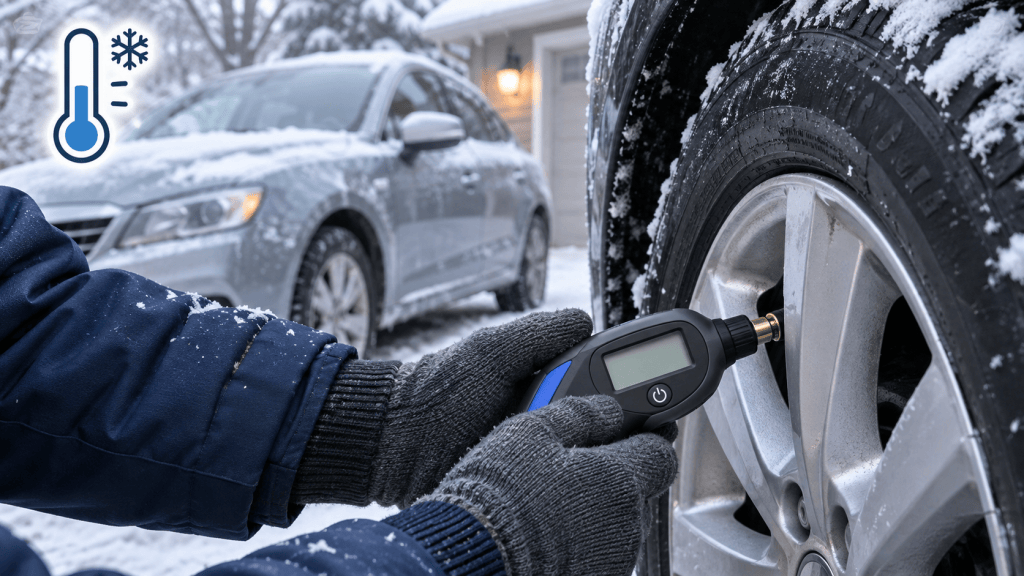
Cold weather lowers tire pressure, even when your tires have no puncture. A tire that was correctly inflated during mild weather may read several PSI lower after a sharp temperature drop. The safest response is to check pressure with a reliable gauge when the tires are cold and inflate to the vehicle manufacturer’s recommended pressure—not the maximum number printed on the tire sidewall.
Why tire pressure falls in winter
Air pressure changes with temperature. Transport Canada estimates that tire pressure drops by about 1 PSI for each 5°C decrease, although actual readings also depend on normal air loss and driving conditions. A tire that reads 35 PSI in a warm period could therefore show a noticeably lower number after a cold snap without necessarily having a leak.
Source: Transport Canada: Inflating your tires.
How to check tire pressure correctly
- Find the vehicle’s tire placard. Look on the driver’s door edge or door jamb, or consult the owner’s manual. Check whether the front and rear recommendations differ.
- Wait until the tires are cold. Transport Canada defines this as the vehicle being stationary for at least three hours or driven less than 2 km.
- Use a pressure gauge. Remove the valve cap, press the gauge squarely onto the valve, and read the pressure.
- Compare each tire with the placard. Add air if necessary, without using the sidewall maximum as the normal target.
- Recheck and replace valve caps. Measure all four tires and the spare if applicable. If one tire repeatedly loses pressure, have it inspected for a leak or damage.
Should you add extra PSI for winter?
Do not automatically add an arbitrary extra amount above the automaker’s cold inflation specification. Use the recommended cold pressure for your particular vehicle and load conditions. If your owner’s manual gives different settings for certain loads or speeds, follow those instructions. A reading taken after driving may be higher because the tires have warmed up; do not bleed down a hot tire just to match the cold placard value.
Winter tires: pressure is only one part of safety
Correct pressure does not turn a summer tire into a winter tire. Transport Canada recommends winter tires for cold, snowy or icy driving, installed as a matched set of four. Look for the three-peaked mountain-and-snowflake symbol when shopping for tires intended for severe snow conditions. Inspect tread depth and visible damage, too.
Quick troubleshooting
The tire-pressure warning light came on overnight
Check all tires with a gauge before driving far. Temperature may be the reason, but do not assume a warning light is harmless: a puncture or damaged tire can produce the same symptom.
One tire loses air faster than the others
Have the tire, wheel and valve inspected by a qualified service provider. Repeatedly topping up a damaged tire is not a substitute for repair.
My dashboard and gauge show different readings
Confirm the gauge is reliable, check cold, and consult the vehicle manual for how its tire-pressure monitoring system displays or resets readings.
Bottom line
Check cold tire pressure at least monthly and after major temperature changes. Keep a small gauge in the car, use the vehicle placard, and inspect any persistent pressure loss. For additional winter safety steps, see Transport Canada’s winter driving guidance.

