
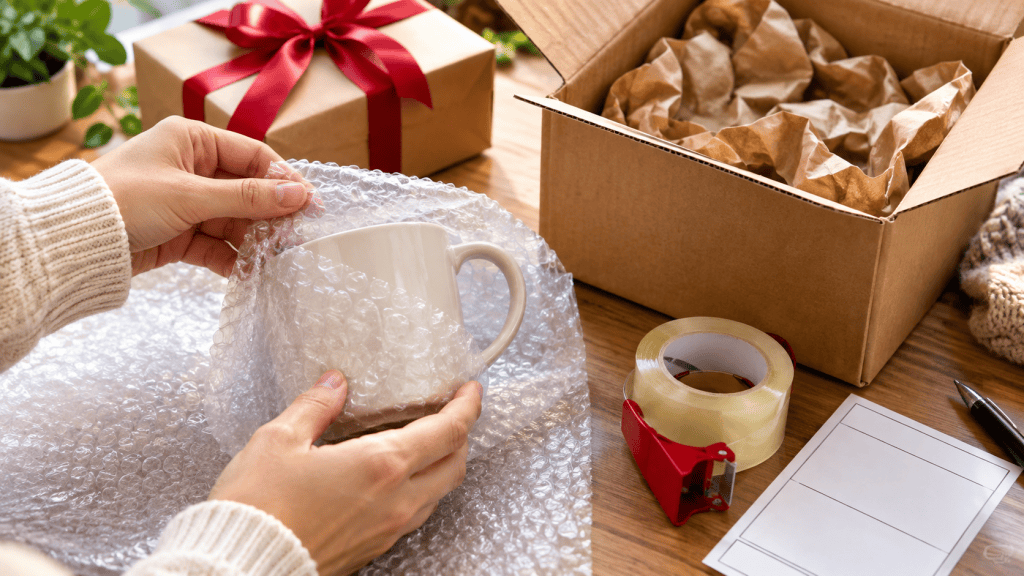
To ship a fragile gift safely, use a sturdy corrugated box, wrap each breakable item separately, cushion every side, prevent movement, and seal the box with packing tape. This practical checklist applies to common gifts such as mugs, glassware, ornaments, and framed photos mailed in the United States or Canada.
What supplies do you need?
- A rigid corrugated shipping box in good condition
- Bubble wrap, crumpled paper, or other suitable protective cushioning
- Strong packing tape and a legible shipping label
- Optional smaller inner box for especially fragile items
Use a box with room for protective padding, but not so much extra space that the contents can shift. Reused boxes should have old shipping labels and barcodes removed or completely covered.
How to pack a fragile gift step by step
1. Inspect the item and the box
Check the gift for existing cracks and photograph it before packing, especially if it is valuable. Choose an undamaged, rigid box that closes without bulging.
2. Wrap each fragile piece individually
Protect handles, corners, rims, and other vulnerable parts. Separate multiple objects so they cannot knock into each other. For framed glass, Canada Post recommends cardboard larger than the frame on both faces, with soft cushioning between the frame and cardboard.
3. Cushion the bottom and every side
Place cushioning underneath the wrapped gift, then fill the side gaps and the space above it. USPS advises cushioning the bottom, sides, and top, and Canada Post emphasizes preventing movement inside the parcel.
4. Test for movement before sealing
Gently tilt the closed-but-unsealed box. If you feel the contents shift, reopen it and add cushioning. Avoid compressing delicate items with excessive packing pressure.
5. Seal all seams and label clearly
Use proper packing tape across the opening and reinforced seams. Put the shipping label flat on the largest suitable face, without wrapping the barcode around an edge or over a seam. Add the destination and return address on a card inside the parcel as a backup.
Which packing material should you choose?
Bubble wrap: Useful around irregular or delicate objects. Crumpled paper: Useful for filling gaps and reducing shifting. Corrugated cardboard: Helpful as a rigid divider or face protector. Foam: Can cushion delicate objects when fitted appropriately. Whatever you use, the important test is whether the object stays protected and immobile.
Common packing mistakes
- Using a flimsy gift box as the only shipping container
- Leaving empty space around glassware
- Placing two mugs together without individual wrapping
- Leaving an old barcode visible on a reused carton
- Assuming a FRAGILE label replaces proper cushioning
- Shipping restricted materials without checking carrier rules
USPS vs Canada Post: what should you check?
Both carriers emphasize sturdy outer packaging, cushioning, secure closure, and readable labels. Canada Post notes that improperly packaged or labeled items can be delayed or refused and that unusual shapes may incur surcharges. Before mailing, check the carrier’s restrictions and obtain a service-specific rate and delivery estimate. Do not assume that a recommended holiday mailing date guarantees arrival.
For USPS, review the official packaging advice and 2026 holiday shipping dates. For Canada Post, see how to wrap a package and parcel packaging requirements.
Frequently asked questions
Can I ship a ceramic mug in its retail gift box?
Use the retail box as an inner box only if it provides protection; place it inside a sturdy shipping carton with cushioning on all sides.
Is writing FRAGILE enough?
No. A label does not prevent impacts or movement. Correct wrapping and cushioning remain essential.
Can I reuse an Amazon or other delivery box?
Yes, if the cardboard is strong and undamaged and you remove or fully cover outdated labels and barcodes.
Does shipping insurance replace good packaging?
No. Review the carrier’s claim terms and packaging obligations before relying on coverage.
Updated November 23, 2026. This is general packing guidance, not a guarantee against damage or an endorsement from either postal carrier.

