
Reviewed November 17, 2026. Airport screening procedures can change; always confirm the current rules before departure.
Quick answer: You can generally pack solid snacks in a carry-on when flying from the United States or Canada. Spreadable, pourable, or gel-like foods—such as jam, peanut butter, yogurt, and many sauces—are treated as liquids or gels at security. For ordinary carry-on liquids, the U.S. TSA uses a 3-1-1 rule, while Canada’s CATSA uses a 100 mL/100 g container limit and one clear 1 L bag. Some medically necessary items and infant supplies have exceptions.
Carry-On Food: Solid vs. Spreadable
The key question is not whether an item is edible. It is whether it behaves like a solid or a liquid, gel, paste, or spread at room temperature. A sandwich or dry crackers are different from a large jar of peanut butter.
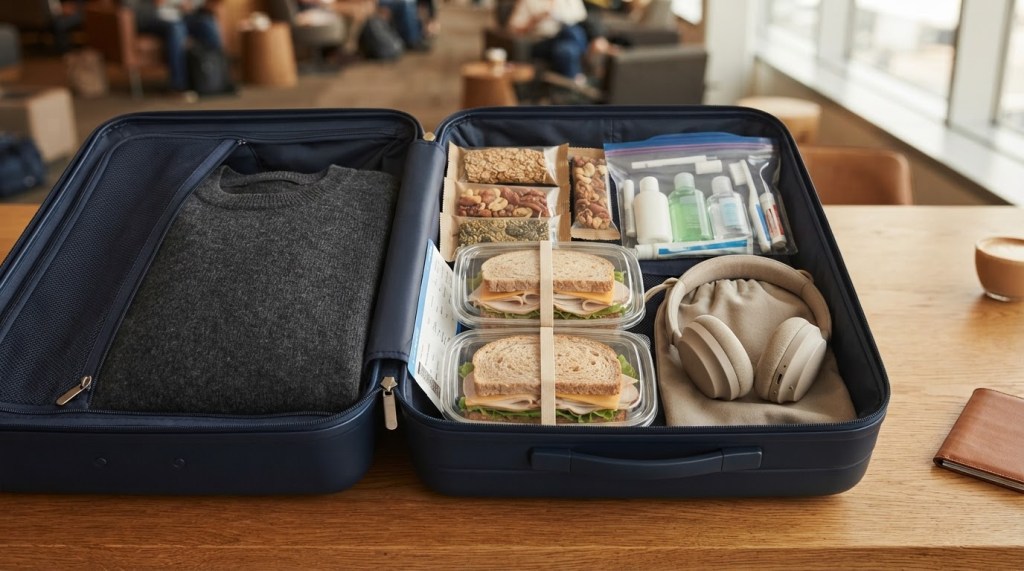
- Usually straightforward: dry crackers, cookies, wrapped sandwiches, granola bars and other solid snacks. Screening officers may still inspect them.
- Plan for the liquids limit: yogurt, hummus, nut butter, jam, gravy, syrup, pudding and creamy spreads.
- Uncertain item? Check the official item-specific screening tool before packing. Do not assume a frozen gel or spread automatically qualifies as solid.
US vs. Canada: Liquid Limits at a Glance
United States: TSA’s 3-1-1 guideline generally means containers of 3.4 fluid ounces (100 mL) or less, fitting in one quart-size clear bag, one bag per passenger. TSA’s travel checklist summarizes this rule.
Canada: CATSA generally limits carry-on liquids, non-solid foods, gels and personal items to containers of 100 mL/100 g or less, fitting together in one transparent, resealable bag no larger than 1 L per passenger. CATSA’s official liquids and food guide provides examples and exemptions.
The limit applies to the container size, not merely how much remains inside. A half-empty full-size jar may still be too large. Airport screening rules also differ from customs and agricultural import rules at your destination.
A 5-Step Holiday Airport Packing Checklist
- Separate solids from spreads: Pack dry snacks together and keep any dips, sauces or spreadable food in properly sized containers.
- Prepare one liquids bag: Put your compliant toiletries and non-solid foods in the same clear bag where required.
- Check exceptions: Infant formula, breast milk, essential medicines and medically necessary liquids can have different screening procedures. Declare and present them for inspection as instructed.
- Consider checked baggage: Larger permitted liquids may go in checked luggage, subject to airline, dangerous-goods and destination restrictions.
- Verify before leaving: Recheck the TSA or CATSA item list, your airline’s baggage policy and any border import restrictions.
What About Baby Food, Breast Milk and Medication?
Do not discard essential supplies simply because they exceed 100 mL. TSA and CATSA provide exemptions for certain infant and medically necessary liquids. Requirements for screening, declaration and inspection can differ. CATSA expressly allows breast milk even when the child is not accompanying the traveler, and has specific provisions for children under two. See CATSA’s exceptions and the TSA What Can I Bring tool.
Common Holiday Packing Mistakes
- Packing a large bottle of maple syrup or a jar of jam in a carry-on because it is a gift. These are non-solid foods and may exceed the limit.
- Assuming a product is permitted just because it is sealed or unopened.
- Confusing airport security approval with permission to import food into another country.
- Putting necessary medications at the bottom of a tightly packed bag where they cannot be presented for inspection.
- Relying on an old social media video rather than current official instructions.
Frequently Asked Questions
Can I take peanut butter through airport security?
A small container within the applicable liquids allowance may be permitted. A full-size jar in a carry-on generally exceeds ordinary limits. Check the departing country’s official guidance.
Can I bring a homemade sandwich?
Generally, solid sandwiches can pass security screening, although officers can inspect them. Customs or destination rules may restrict certain ingredients when crossing borders.
Can I bring an empty water bottle?
An empty bottle is generally suitable for carry-on screening; refill it after security where drinking water is available. A full bottle of water typically exceeds the ordinary liquids allowance.
Does freezing yogurt or sauce make it exempt?
Do not rely on that strategy. CATSA states that foods normally liquid or gel-like at room temperature are not treated as solid merely because they are frozen. Check TSA’s current item-specific rules for U.S. departures.
Official Sources
- TSA — Travel Checklist and 3-1-1 rule
- TSA — What Can I Bring?
- CATSA — Liquids, Non-solid Food & Personal Items
- CATSA — How to Pack Your Carry-on
This guide describes screening preparation, not a guarantee that any individual item will be admitted. Screening officers make the final decision; airline and destination rules may add restrictions.

