
Updated November 16, 2026
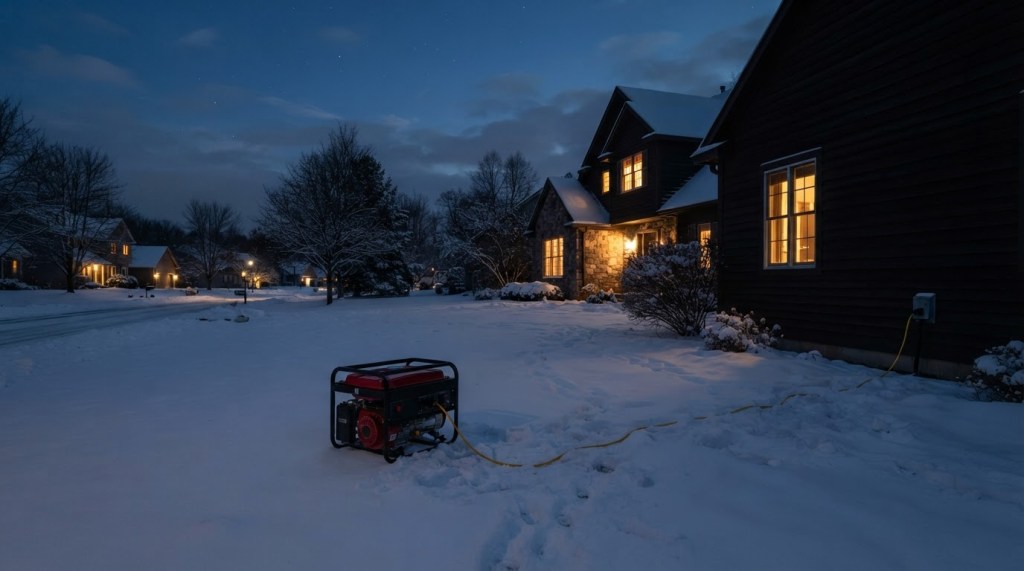
Portable generator safety starts with outdoor placement and carbon monoxide protection. If winter weather knocks out power, a generator can keep essential devices running—but unsafe placement or wiring can turn a power outage into an emergency. Here is a practical checklist for US and Canadian households.
Quick Answer: Where Should a Portable Generator Go?
A fuel-burning portable generator belongs outside, in open air, at least 20 feet (6 metres) from the home or other buildings, with its exhaust pointed away from doors, windows and vents. Never run one in a garage, shed, basement, or under an awning—even with doors open. Keep working carbon monoxide (CO) alarms inside the home. Canadian federal guidance specifically calls for this 6-metre separation; always follow additional local and manufacturer requirements.
Official guidance: Government of Canada: Power outages and Health Canada: Preventing carbon monoxide exposure.
Before a Storm: Decide What You Actually Need to Power
Start with an appliance list, not the biggest generator advertised. Prioritize essentials such as a refrigerator, a few lights, phone charging and medically necessary devices. Check each device’s running watts and startup/surge watts on its label or manual. Add loads that could operate simultaneously, then choose equipment whose manufacturer-rated capacity safely accommodates both running and startup demand. Do not assume every household appliance can run at once.
If you rely on electrically powered medical equipment, contact your provider and utility before a storm to arrange a reliable backup plan. A consumer generator should not be your only contingency for life-supporting equipment.
Portable Generator vs Battery Power Station: What’s the Difference?
| Feature | Fuel-burning portable generator | Battery power station |
|---|---|---|
| Carbon monoxide | Produces CO; outdoor use only | No combustion exhaust during battery operation |
| Runtime | Depends on fuel supply and load | Depends on usable battery capacity and load |
| Noise and maintenance | Engine noise, fuel handling and engine maintenance | Typically quieter; requires charging and battery care |
| Best fit | Longer outages when outdoor placement and fuel storage are practical | Small electronics, limited loads and indoor backup within product ratings |
A battery power station is sometimes marketed as a ‘solar generator.’ It is not the same as a gasoline or propane engine generator. The power station itself does not produce combustion exhaust, but any separate fuel-burning equipment used to recharge it must remain outdoors. Compare continuous output, surge capacity, usable watt-hours, charging time and battery warranty before buying.
Safe Setup Checklist for a Fuel-Burning Generator
- Read the exact model manual and local rules before first use. Test the equipment before an emergency, not during a storm.
- Position it outdoors at least 20 feet (6 metres) from buildings and direct exhaust away from openings. Never put it in a garage, shed, basement, porch enclosure or under a covered area.
- Place it on a stable, dry surface and protect it from rain or snow only with a manufacturer-approved outdoor enclosure that preserves safe ventilation. Never improvise an enclosed tent.
- Install and test carbon monoxide alarms with battery backup near sleeping areas according to local requirements and the alarm manufacturer.
- Connect approved appliances directly or use appropriately rated outdoor extension cords in good condition. Avoid overloading the generator or cords.
- Never connect a generator to a wall outlet (‘backfeeding’). Whole-home connections require a professionally installed, approved transfer switch or equivalent interlock system as permitted locally.
- Turn the generator off and let it cool before refueling. Store fuel only in approved containers and in locations allowed by fire codes.
What to Do if the Carbon Monoxide Alarm Sounds
Leave the building immediately for fresh air. Call 911 or your local emergency service once outside. Do not re-enter until emergency responders or qualified professionals say it is safe. Carbon monoxide cannot be detected by smell or sight. Do not spend time trying to locate the source before evacuating. This is an emergency response, not a troubleshooting step.
A Practical Power-Outage Plan for US and Canadian Households
1. Make a two-column essentials list
Separate ‘must power’ from ‘nice to power.’ A small refrigerator and phone charging may matter more than entertainment equipment. Note whether a refrigerator has a compressor startup surge.
2. Choose a safe operating location before winter
Measure the distance from the house, doors, windows and vents, and identify a safe route for properly rated cables. Consider whether snowbanks, ice, wind direction or flooding could make that location unusable.
3. Prepare for outages without a generator
Keep charged power banks, flashlights, spare batteries, warm clothing and an emergency contact plan. Use flashlights instead of candles to reduce fire risk. Never heat a home with a gas stove, barbecue, camping stove or other outdoor cooking equipment.
4. Know when to call an electrician
If you want to power circuits in the home’s electrical panel rather than plug in individual appliances, consult a licensed electrician about an approved transfer arrangement. Do not attempt a do-it-yourself backfeed connection.
Frequently Asked Questions
Can I run a generator in the garage with the door open?
No. An open garage door does not make an engine generator safe indoors or in an attached garage. Operate it outside at the recommended separation distance.
Can I run a portable generator on a balcony or covered porch?
Do not assume a balcony or covered porch is safe. Enclosed or partly enclosed spaces can trap exhaust, and proximity to windows and air intakes is hazardous. Use a suitable open-air location consistent with the manual and local rules.
Is a carbon monoxide shutoff sensor enough?
No. An automatic CO shutoff feature is useful, but it does not make indoor operation safe or replace household CO alarms.
Can I plug my generator into a dryer outlet?
No. Never backfeed a home through an appliance outlet. A qualified electrician must install any permitted home electrical connection.
Official Sources and Further Reading
- Government of Canada — Power Outages: How to Prepare
- Health Canada — Carbon Monoxide: Preventing Exposure
- Health Canada — Backyard and Outdoor Safety
- US National Weather Service — Winter Safety
Reviewed November 16, 2026. This article is general safety education, not a substitute for the generator manual, local electrical and fire codes, or emergency instructions. No specific model or price is endorsed.

