
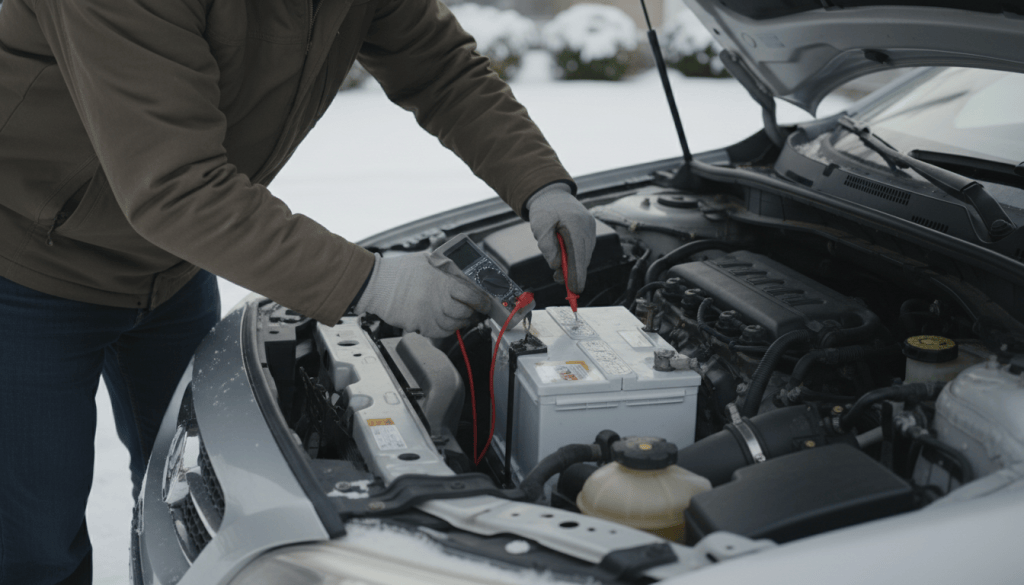
A car battery that works on a mild afternoon can struggle on a freezing morning. The practical answer is to check the battery’s condition, connections and charging system before temperatures fall—and to have a weak battery tested rather than waiting for a no-start situation.
Why cold weather makes starting harder
Cold conditions reduce the effective power a conventional 12-volt battery can deliver, while starting an engine can demand more effort. Age, repeated short trips, loose terminals and charging-system problems can make the situation worse. A slow crank is a warning sign, not proof that the battery alone is defective.
Five checks before the first deep freeze
1. Look for slow starts and electrical warnings
Notice whether the starter turns more slowly than usual, the car needs repeated attempts, or battery and charging warnings appear. A warning light while driving can indicate a charging-system problem and should be assessed promptly.
2. Inspect the battery safely
With the vehicle off and following the owner’s manual, visually check for a damaged case, loose mounting and obvious corrosion around terminals. Do not touch leaking electrolyte or attempt to open a sealed battery. Keep metal tools away from exposed terminals; accidental short circuits are dangerous.
3. Request a battery and charging-system test
An automotive shop can evaluate battery condition and whether the alternator or charging system is operating properly. A voltage reading alone does not always establish how much starting capacity remains. Ask for the test result and whether replacement is recommended, especially if the battery is aging or starts have become sluggish.
4. Check your driving pattern
Frequent very short journeys and long periods of parking can leave a battery undercharged. If your vehicle sits for weeks, ask a qualified technician about a manufacturer-approved battery maintainer and its safe connection procedure. Never improvise charging near flammable vapors or in an unventilated location.
5. Plan for a safe no-start response
Keep an appropriate phone charger and roadside-assistance contact handy. If using booster cables or a jump starter, follow the exact vehicle and equipment instructions: some hybrids and electric vehicles have special 12-volt procedures and restrictions. If you are unsure, call roadside assistance.
When should you replace the battery?
There is no universal replacement date. Climate, battery design, vehicle usage and testing results matter. A professional test showing weak performance, physical damage or repeated starting trouble is a stronger reason to act than age alone. A replacement should match the vehicle manufacturer’s battery specifications, including required technology and sizing.
Frequently asked questions
Will idling recharge a weak battery?
It may add some charge, but it is not a reliable substitute for diagnosis or an appropriate charger. Avoid idling in enclosed spaces because of carbon monoxide risk.
Can a new battery still go flat?
Yes. An electrical drain, charging fault, accessory use or extended storage can discharge even a new battery.
Does this apply to EVs?
Many EVs have a separate low-voltage system, but their starting and charging procedures differ from gasoline vehicles. Use the specific EV manual.
Official sources
Transport Canada, Preparing your vehicle for winter; Government of Canada, Be prepared for winter weather.
Updated November 12, 2026. General maintenance information, not a substitute for the vehicle manual or a qualified inspection.

