
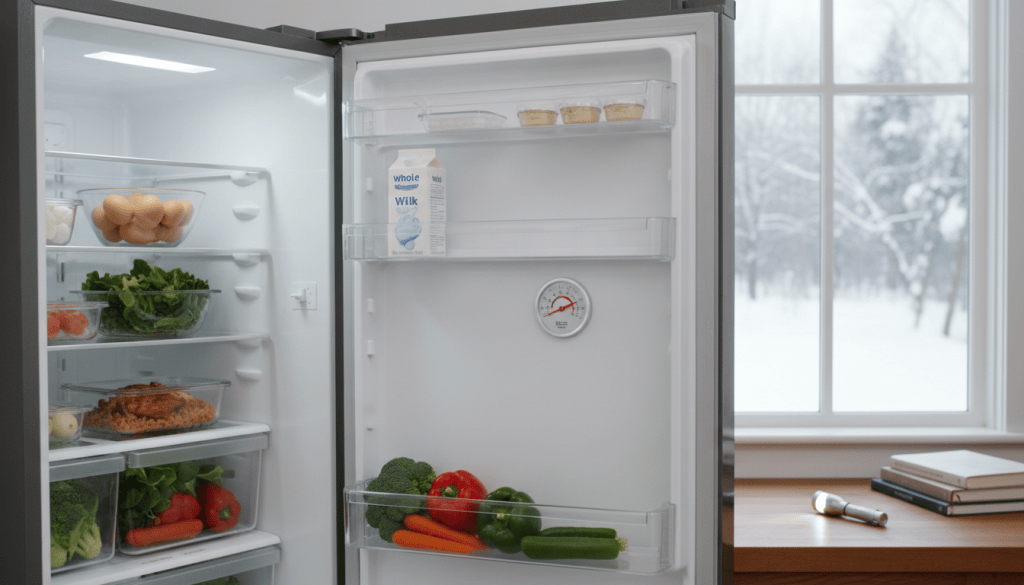
During a power outage, an unopened refrigerator generally keeps food cold for about four hours; a full unopened freezer for about 48 hours, or about 24 hours if half full. Those are planning estimates, not guarantees. Temperature measurements and the food’s condition determine what is safe to keep.
Quick refrigerator and freezer timeline
- Refrigerator: about four hours with the door closed.
- Full freezer: about 48 hours if unopened.
- Half-full freezer: about 24 hours if unopened.
These guidelines come from the US government’s FoodSafety.gov emergency food safety guidance. Appliance insulation, ambient temperature and door openings can change outcomes.
Before a winter storm: five useful preparations
- Put appliance thermometers in the refrigerator and freezer. Target 40°F (4°C) or colder in the fridge and 0°F (-18°C) or colder in the freezer.
- Freeze ice packs and containers of water, leaving expansion space.
- Group frozen items together to help retain cold.
- Prepare a cooler and a source of ice for a longer outage.
- Keep a three-day supply of shelf-stable food and safe water for household members, including pets and special diets.
What to do while the power is out
Keep refrigerator and freezer doors closed. Note when power failed. Use flashlights rather than open flames. If you expect a prolonged outage, move perishables to an ice-filled cooler that can maintain 40°F (4°C) or below. Do not put perishable food directly into outdoor snow: outdoor temperatures fluctuate and food may be contaminated by animals or dirt.
Never operate a generator, grill or camp stove indoors or in an attached garage. See Ready.gov’s power outage safety sheet for carbon monoxide and electrical precautions.
After power returns: what can you keep?
Discard refrigerated perishable foods such as meat, poultry, fish, eggs and leftovers after four hours without power if they were not kept at safe temperatures. If a perishable item has been above 40°F (4°C) for more than two hours, discard it. Frozen food can often be refrozen or cooked if it still has ice crystals or measures 40°F (4°C) or below. Never taste food to test its safety.
Use the item-by-item FoodSafety.gov keep-or-discard chart, especially for dairy, produce, sauces and prepared meals. When you cannot establish safe temperatures, discard questionable perishables.
FAQ
Does a freezer stay safe for two days?
A full unopened freezer may hold safe temperatures for roughly 48 hours, but check individual items and temperatures afterward.
Can I leave milk in the snow?
No. Snow is not a controlled refrigerator, and food can become contaminated.
Can I refreeze thawed meat?
Only if it still has ice crystals or has remained at 40°F (4°C) or below; follow official item-specific guidance.
Source check: FoodSafety.gov and Ready.gov guidance, reviewed November 11, 2026. This is general food safety information, not a substitute for local public-health advice.

