
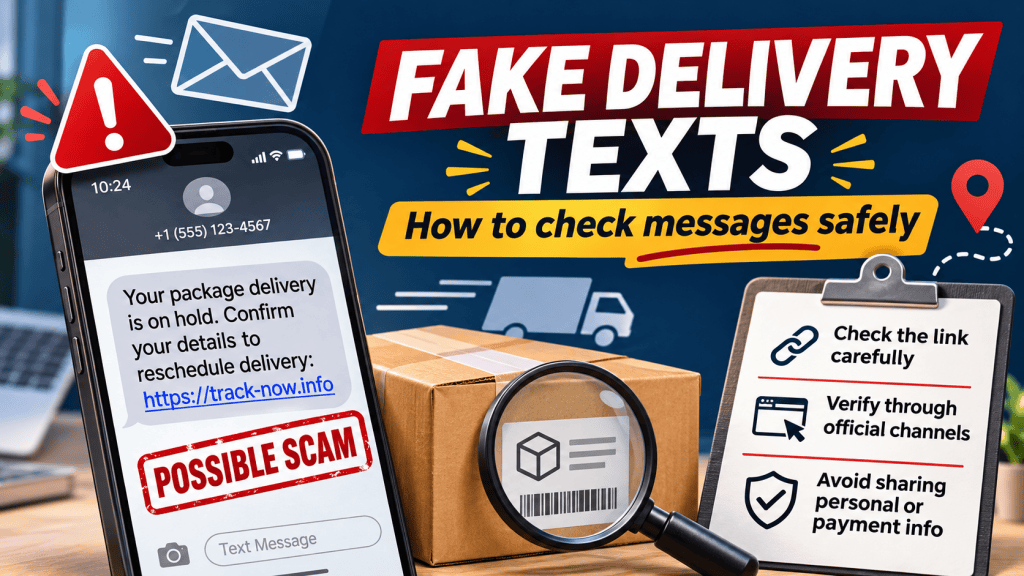
Updated November 7, 2026. A text claiming your package cannot be delivered because of an incomplete address or unpaid fee may be a scam—even when you are expecting a real parcel. The safest first step is not to use the message’s link. Open the retailer’s order page or the postal carrier’s official website yourself and check the tracking number there. This guide covers the U.S. and Canada, with practical examples and official sources.
What a fake delivery text usually says
- Your package is on hold until you pay a small redelivery or customs fee.
- A delivery failed because the address is incomplete; tap a link to correct it.
- Your parcel will be returned unless you act immediately.
- A tracking page asks for your card number or password before showing a status.
The U.S. Federal Trade Commission warns that look-alike shipping sites are designed to collect payment and personal information. The message may arrive at exactly the moment you expect a parcel. That coincidence does not prove it is legitimate.
How to verify a USPS package message
- Do not click the embedded link, even if it appears to contain a familiar brand name.
- Open the seller’s app or order-confirmation email you already trust, and copy the tracking number.
- Manually visit the official USPS website or use its app to check the tracking status.
- If the tracking number is not recognized, contact the seller through your original order page—not the number in the text.
- Block or report suspicious texts. In the United States, forwarding an unwanted message to 7726 can help your mobile provider identify spam.
The FTC advises checking the retail order or carrier account independently rather than following an unexpected text. See its USPS text impersonation alert.
How to verify a Canada Post package message
Canada Post states that it does not send texts asking for credit-card or banking information, account login details, or payments to release deliveries or see tracking. Instead, open Canada Post’s official tracking site or its mobile app yourself. A legitimate tracking notification is not a reason to enter payment details into a site reached from an unexpected message.
Canada Post identifies 272727 and 55555 as notification short codes for opted-in tracking or marketing messages, with some customer support communications from designated phone numbers. Sender information can still be misleading; always verify through the official site. Read the Canada Post fraud-message guidance.
What if you already clicked?
- Clicked only: Close the page. Do not download files or grant browser permissions. Update your browser and device if necessary.
- Entered a password: Change it immediately using the real service website, and enable multifactor authentication where available.
- Entered card details: Contact the card issuer using the number on the card or official banking app. Explain that the information may have been exposed.
- Installed an app or profile: Stop using it and follow your device maker’s security-removal instructions; consider professional help if you cannot remove it.
- Paid a fake fee: Save screenshots and contact your payment provider promptly about available dispute options.
If you are in the United States, report the scam through the FTC fraud reporting portal. In Canada, Canada Post points victims toward the Canadian Anti-Fraud Centre and advises forwarding spam texts to 7726.
Five warning signs to remember
- The message creates an urgent deadline for a package you cannot identify.
- The web address is a look-alike rather than the carrier’s real domain.
- It asks for a password, card number or banking information just to see a tracking update.
- It offers an unsolicited delivery prize or refund in exchange for a fee.
- It arrives from an unknown sender and is unrelated to your original retailer account.
Poor grammar can be a clue, but polished messages can also be fraudulent. A genuine-looking logo is not evidence that the page is real.
Frequently asked questions
Can a real delivery be delayed by customs fees? Yes, some shipments may legitimately have duties or taxes. The point is to verify any amount directly through the carrier’s authenticated channels, not a surprise text link.
Does an HTTPS padlock prove a delivery website is legitimate? No. Encryption alone does not verify who operates the site.
What if I am expecting a package today? Open the order in the retailer’s app or visit the carrier site by typing the known address yourself.
Bottom line
Do not let a delivery text decide where you enter personal information. Verify tracking independently, treat unexpected payment requests as suspicious, and act quickly if you shared card details or a password. Official references: FTC delivery-text advice and Canada Post anti-fraud guidance.

