
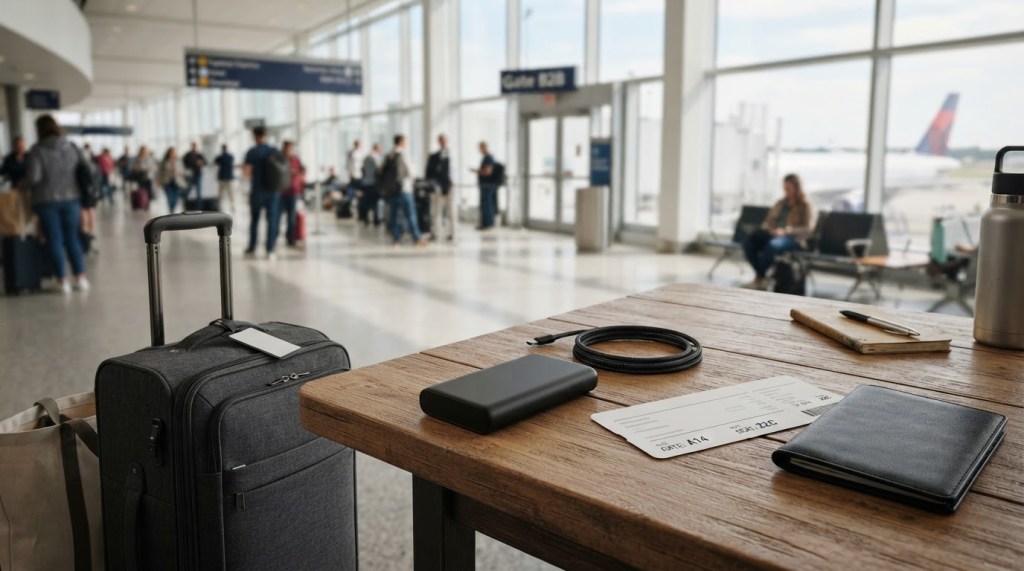
Yes, you can generally bring a power bank on a flight, but it belongs in your carry-on—not checked baggage. For most lithium-ion portable chargers, the key limit is 100 watt-hours (Wh). Larger batteries may require airline approval, and your carrier may have stricter rules. This guide explains how to check capacity before a US or Canadian flight.
Quick answer: where should a power bank go?
| Power bank rating | Practical packing decision |
|---|---|
| Up to 100 Wh | Generally carry-on only; check airline-specific limits |
| Over 100 through 160 Wh | Ask your airline for advance approval; limits on larger spare batteries apply |
| Over 160 Wh | Do not bring on a passenger aircraft under the standard US rules |
| Damaged, swollen or recalled | Do not fly with it; arrange safe handling instead |
The US Federal Aviation Administration (FAA) says power banks are spare lithium batteries and must stay in the passenger cabin. If staff gate-check your carry-on, remove the power bank first. See the FAA PackSafe lithium battery guidance.
How to calculate watt-hours from mAh
Manufacturers often advertise milliamp-hours (mAh), while aviation rules use watt-hours (Wh). The calculation is Wh = (mAh ÷ 1,000) × nominal battery voltage. Use the battery’s specified nominal voltage, not its USB output voltage.
| Example capacity | At a nominal 3.7 V | Interpretation |
|---|---|---|
| 10,000 mAh | 37 Wh | Below 100 Wh |
| 20,000 mAh | 74 Wh | Below 100 Wh |
| 26,800 mAh | 99.16 Wh | Near the usual threshold |
| 30,000 mAh | 111 Wh | Airline approval may be required |
These are examples only: actual products may use different voltages or have different labeled Wh ratings. Read the label on your own device. If the label is missing or unclear, ask the manufacturer and airline rather than assuming that the advertised mAh number proves compliance.
US flights: what the FAA requires
FAA guidance allows most personal-use spare lithium-ion batteries up to 100 Wh in carry-on baggage. For larger spares rated 101–160 Wh, airline approval and a limit of two such spares per passenger apply. Airlines can impose tighter limits, including limits on the number of portable chargers. The FAA passenger battery FAQ explains the categories.
Do not put a loose power bank into a checked suitcase. Protect exposed contacts from short circuits using original packaging or a protective pouch. Keep it accessible during travel. If it becomes unusually hot, swells, smokes or burns in flight, alert the cabin crew immediately rather than attempting to handle a fire yourself.
Canadian departures: check CATSA and your airline
Canada’s air-security screening authority, CATSA, recommends carrying batteries and battery-powered electronics in carry-on baggage, keeping spare batteries protected, and consulting your airline about restrictions. Its battery travel guidelines and 100 Wh lithium battery guidance provide the starting point.
For larger batteries, review the CATSA 101–160 Wh guidance and ask your airline. Screening guidance, dangerous-goods transport rules and airline acceptance policies are not always identical; the airline can apply more restrictive conditions. On international itineraries, check each operating carrier, including connecting flights.
What to look for when buying a travel power bank
1. Clearly printed Wh capacity
Choose a model with an easy-to-read capacity label and manufacturer documentation. A 20,000 mAh bank at 3.7 V is about 74 Wh, but verify the actual rating.
2. Useful charging ports and output
Check whether your phone, tablet or laptop uses USB-C and what charging power it accepts. A higher-wattage output can be useful for laptops, but it does not override aviation capacity rules.
3. Portability and safety
Consider weight, dimensions, a protective case, reputable manufacturer support and recall information. Avoid visibly damaged, swelling or unusually hot batteries.
4. Airline-specific policies
Some carriers restrict in-flight charging or where power banks may be stored. Review the airline’s current dangerous-goods page immediately before departure.
Five-minute packing checklist
- Find the Wh rating on your power bank; calculate it from mAh and nominal voltage only if necessary.
- Compare it against your airline’s current size and quantity restrictions.
- Put the bank in your carry-on or personal item, never your checked bag.
- Protect exposed contacts and keep the battery away from loose metal objects.
- If your carry-on is gate-checked, remove the bank and retain it in the cabin.
Frequently asked questions
Can I bring a 20,000 mAh power bank?
Often yes: at 3.7 V, 20,000 mAh equals 74 Wh. Check the actual label and airline policy before travel.
Can I put a power bank in checked luggage?
No under the FAA’s rules for spare lithium batteries, including power banks. Carry it in the cabin.
Can I bring two power banks?
Often, but quantity rules vary by capacity and airline. The FAA sets a specific two-spare limit for the larger 101–160 Wh category and warns that airlines may set stricter rules for all sizes.
Does TSA or CATSA approval guarantee the airline will accept it?
No. Security screening guidance is not a substitute for your airline’s dangerous-goods policy.
Official sources and last check
- FAA — PackSafe: Lithium Batteries
- FAA — Airline Passengers and Batteries
- CATSA — Guidelines for Batteries
- CATSA — Larger Lithium-Ion Batteries
Official guidance checked November 19, 2026. Airline policies can change; verify them before each flight. This article is a general packing guide, not an airline approval.

