
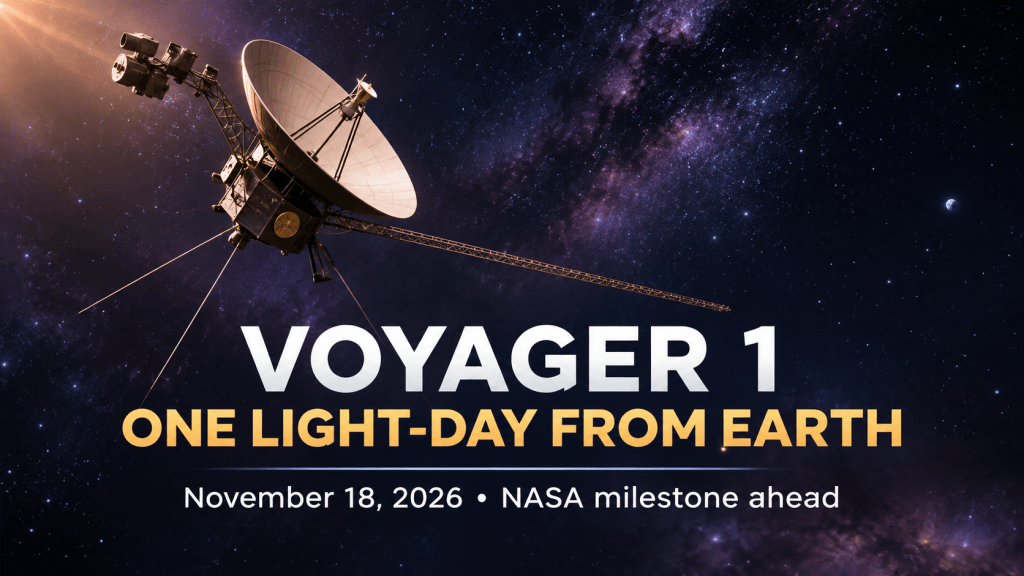
Updated November 3, 2026. NASA’s Voyager 1 is approaching a first in space exploration: on November 18, 2026, at 5:16:07 a.m. Eastern Standard Time, the agency expects the probe to be one light-day from Earth. That is the distance light—or a radio signal—travels in 24 hours. Despite its nearly five-decade journey, the spacecraft is still communicating with mission controllers. Here is what the milestone actually means, how far away it is, and what recent spacecraft updates tell us.
Illustration note: The featured image is AI-generated artwork representing the milestone, not a NASA spacecraft photograph. The November 18 crossing is still a future event as of this article’s publication date.
Voyager 1’s one-light-day milestone at a glance
- Expected date: Wednesday, November 18, 2026.
- Expected time: 5:16:07 a.m. EST (2:16:07 a.m. Pacific Standard Time).
- Distance from Earth: approximately 16.095 billion miles (25.902 billion kilometers).
- One-way radio travel time: roughly 24 hours at the milestone.
- Minimum signal round trip: roughly 48 hours, before accounting for processing and operations.
- Mission status as of November 3: active, with communications restored following a brief interruption in October.
These figures come from NASA’s explanation of a light-day and its October 29, 2026 Voyager update. The exact crossing time is a NASA projection, not a milestone that has happened yet.
What is a light-day?
A light-day measures distance, not elapsed mission time. Light travels through a vacuum at about 299,792 kilometers (186,282 miles) per second. Multiply that speed by 86,400 seconds in a day, and you get a distance of about 25.902 billion kilometers, or 16.095 billion miles.
A light-day is similar in concept to a light-year, but it covers one day of light travel rather than one year. Scientists use light-based distance units because ordinary miles and kilometers become difficult to visualize across the solar system and beyond.
How far is one light-day compared with familiar space distances?
The simplest way to understand Voyager 1’s distance is to compare the travel time of light or radio waves from other objects:
- Earth to the Moon: about 1.3 light-seconds on average.
- Sun to Earth: about 8 minutes and 20 seconds.
- Earth to Mars: roughly 3 to 22 light-minutes, depending on the planets’ positions.
- Earth to Neptune: about 4 hours and 10 minutes of light travel using NASA’s reference comparison.
- Earth to Voyager 1 on November 18: a full 24 hours of light travel.
These are reference examples, not fixed distances for moving planets. NASA discusses the comparisons in its light-day explainer.
When exactly will Voyager 1 reach one light-day?
NASA’s projected date is November 18, 2026, at 5:16:07 a.m. EST. The equivalent Pacific time is 2:16:07 a.m. PST. Both the United States and Canada in the Eastern Time zone will be observing standard time by then.
The milestone is based on Voyager 1’s distance from Earth at that time. It is not its distance from the Sun, and the probe will not encounter a special wall or physical boundary at one light-day. This is a distance marker, not an event that changes the spacecraft or the environment around it.
Because the spacecraft and Earth keep moving, the NASA mission tracker is the best place to check current figures: Where Are Voyager 1 and Voyager 2 Now?
Why does NASA have to wait almost two days for a reply?
NASA communicates with Voyager through the Deep Space Network, a global network of powerful antennas for spacecraft far beyond Earth. Radio waves travel at the speed of light, so no ordinary command can arrive instantly.
At one light-day, a command transmitted from Earth needs around 24 hours to reach the spacecraft. A response takes around another 24 hours to travel back. That is a 48-hour minimum signal round trip, even before spacecraft processing, antenna scheduling, and other operational delays.
That means a seemingly simple troubleshooting exchange can span multiple days. Mission controllers must plan commands carefully and rely on onboard systems to protect the spacecraft when something unexpected happens.
Is Voyager 1 still working in November 2026?
Yes, based on NASA’s latest published update available as of November 3. The mission recently experienced a communications interruption, but contact resumed.
NASA says its Deep Space Network did not detect Voyager 1 during scheduled contacts on October 18 and 19, 2026. The spacecraft’s radio signal returned on October 20, and the team reported maintaining communication afterward. Engineers were still examining the reason for the interruption. NASA also reported that one set of thrusters went offline and backup thrusters activated as part of the spacecraft’s automatic fault-protection behavior.
This matters because a temporary loss of contact is not the same as a confirmed end to the mission. The most responsible answer is to follow NASA’s October 29 mission report for confirmed status rather than treating social-media claims as evidence.
How can a spacecraft launched in 1977 keep operating?
Voyager 1 launched on September 5, 1977, initially to study Jupiter and Saturn. It went on to become the most distant human-made object and crossed into interstellar space in August 2012, moving beyond the Sun’s heliosphere—the region dominated by the solar wind and its magnetic influence.
Unlike spacecraft with conventional solar panels, Voyager 1 uses a radioisotope thermoelectric generator that converts heat from radioactive decay into electricity. The available power has gradually declined. NASA says each Voyager loses roughly four watts of power per year, so engineers periodically disable equipment or change operating arrangements to preserve essential functions.
In April 2026, NASA shut down Voyager 1’s Low-Energy Charged Particles experiment to conserve electricity. In September 2026, engineers completed another power-saving reconfiguration that swapped three devices for alternatives with lower power requirements. NASA said this step should allow its remaining scientific instruments to operate longer than previously anticipated.
The milestone therefore says as much about long-term engineering and mission operations as it does about distance. See NASA’s Voyager 1 mission overview and April 17 instrument update for additional background.
Does reaching one light-day mean Voyager 1 has left the solar system?
Not in every definition of the term. Voyager 1 has been in interstellar space since 2012 because it crossed the heliopause, where the solar wind gives way to the interstellar environment. But the solar system’s gravitationally related outer region, commonly discussed in connection with the distant Oort Cloud, extends much farther. Crossing one light-day is not the same as crossing that outer boundary.
NASA explains the difference in its Voyager frequently asked questions.
How can you track Voyager 1 in real time?
NASA provides a public Voyager distance and mission-status page with current-position information, along with a 3D Eyes on the Solar System visualization that helps you explore spacecraft trajectories.
- Open NASA’s Voyager mission-status page and look for the Voyager 1 distance readout.
- Remember that the figure is a distance measurement, not an estimate of how many years the spacecraft has been traveling.
- Check the NASA Voyager news feed for any changes to mission status or the projected milestone time.
- On November 18, verify NASA’s report before describing the crossing as completed.
Frequently asked questions
Is a light-day the same as 24 hours of spacecraft travel?
No. A light-day is how far light travels in 24 hours. Voyager 1 has needed almost 50 years to travel this far because it moves dramatically slower than light.
Can Voyager 1 take pictures of Earth today?
Voyager 1 is not currently operating as a camera mission. Its famous 1990 “Pale Blue Dot” image of Earth came from an earlier stage of the mission, not a picture being taken at the upcoming one-light-day milestone.
Will Voyager 1 stop working when it crosses one light-day?
No sudden change is expected simply from crossing that distance. The spacecraft’s future operations depend on available electrical power, component health, communication links, and mission decisions.
When might Voyager 2 reach one light-day?
NASA currently estimates that Voyager 2 could reach the same Earth-distance milestone around November 2035. The twin probes followed different paths.
Final takeaway
As of November 3, NASA expects Voyager 1 to reach one light-day from Earth on November 18, 2026. The key takeaway is not that a spacecraft suddenly changes behavior at an invisible border; it is that humanity’s farthest probe is so distant that a radio message must travel for an entire day just to reach it. For a mission launched in 1977, continuing scientific operations and communication at such a distance is the greater achievement.
Primary sources: NASA — What Is a Light-Day?; NASA — Voyager position tracker; NASA — October 29, 2026 mission update; NASA — Voyager 1 overview.

