
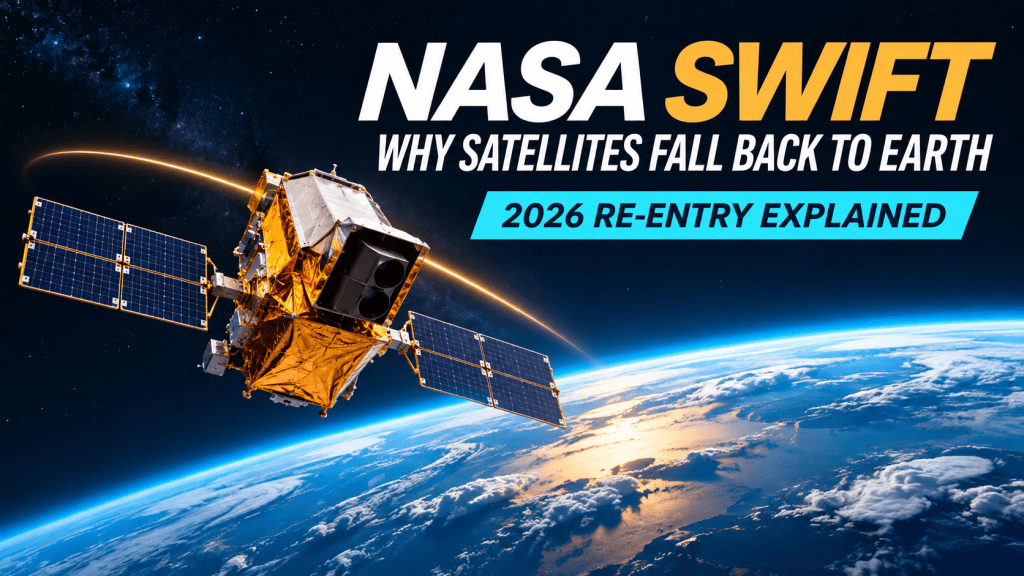
NASA’s Neil Gehrels Swift Observatory, a spacecraft that spent nearly 22 years watching some of the universe’s most energetic events, is approaching the end of its time in orbit. NASA ended the telescope’s scientific operations in October 2026 and expects it to reenter Earth’s atmosphere.
That news raises several practical questions: When will Swift reenter? Why is a space telescope falling toward Earth? Can satellite debris survive, and is there any reason to worry? Here’s what NASA has confirmed, what remains uncertain, and how satellite reentry works.
Swift Reentry: What Is Confirmed as of November 2, 2026
Status update — November 2, 2026: NASA’s latest Swift mission announcements reviewed for this article confirm that science operations ended after the final observation on October 20, 2026. NASA’s October 23 announcement anticipated atmospheric reentry in the following weeks. We have not found a newer official NASA confirmation that Swift has already reentered, nor an authoritative final reentry location or timestamp.
Independent forecasts reported on November 1 pointed to a possible early-November reentry window, but such estimates can change rapidly. The expected time should not be reported as an exact landing appointment. For updates, use NASA’s Swift mission blog.
| Question | Confirmed information |
|---|---|
| What spacecraft? | NASA’s Neil Gehrels Swift Observatory |
| Launch date | November 20, 2004 |
| Original primary mission | Two years |
| Final science observation | October 20, 2026 |
| Orbit at mission end | Approximately 275 km (171 miles) |
| Reentry timing | Expected after mission shutdown; exact final time not confirmed in sources reviewed |
| Reentry location | Not confirmed |
What Was the Neil Gehrels Swift Observatory?
Swift was a space telescope designed to detect and study gamma-ray bursts, intense, brief flashes of high-energy light from distant cosmic events. The mission used a combination of gamma-ray, X-ray, ultraviolet, and optical instruments to spot an event and quickly follow it with other observations.
The spacecraft could locate a burst, alert other observatories, and turn its own instruments toward the source—typically within about a minute. That speed helped astronomers observe fleeting events that might otherwise disappear before a telescope could investigate.
Swift launched on November 20, 2004. Although its primary mission was intended to last only two years, the observatory continued delivering valuable measurements for more than two decades. NASA renamed it in 2018 in honor of astronomer Neil Gehrels, the mission’s first principal investigator.
Why Is the Swift Satellite Falling Back to Earth?
The main reason is atmospheric drag. Space at a few hundred kilometers above Earth is extremely thin, but it is not a perfect vacuum. Small numbers of atmospheric particles continuously push against low-Earth-orbit spacecraft.
Over time, drag takes energy from an orbiting satellite. The satellite moves into a lower orbit, encounters denser atmospheric conditions, and experiences more drag. The effect can eventually become self-reinforcing as the spacecraft approaches reentry.
How Solar Activity Accelerated Swift’s Descent
NASA says increased solar activity contributed to Swift’s faster orbital decline. Solar energy can heat and expand Earth’s upper atmosphere, increasing the amount of atmospheric material encountered by a satellite at a given height.
On October 20, Swift had dropped to about 275 kilometers (171 miles). NASA says the drag became too strong for the spacecraft to maintain the stable pointing needed for science observations. The spacecraft entered safe mode, and its team ended operations in preparation for reentry.
This does not mean all satellites suddenly fall when the Sun becomes active. The effect depends on orbital altitude, spacecraft properties, atmospheric conditions, and whether an operating satellite can adjust its orbit.
Why Didn’t NASA Save the Swift Telescope?
NASA and a commercial partner attempted an innovative plan to extend Swift’s mission by using another spacecraft to raise its orbit. The servicing effort was intended to counter the loss of altitude and allow the observatory to keep operating.
But the proposed boost did not happen. NASA explained that a commercial servicing mission ended without raising Swift’s orbit after the servicing spacecraft encountered difficulties. NASA’s September 28 update discusses what the teams learned from the attempt.
The important distinction is that Swift’s scientific mission ended because of orbital conditions; NASA did not describe the satellite as a telescope that had simply run out of interesting objects to observe.
What Happens When a Satellite Reenters Earth’s Atmosphere?
As an orbiting object descends into denser layers of the atmosphere, the forces acting on it rise quickly. Intense aerodynamic heating and structural stress may break it apart.
- First, orbital decay: Drag reduces the satellite’s altitude over time.
- Next, rapid heating and breakup: As air density increases, the spacecraft may fragment and many pieces are destroyed.
- Finally, possible surviving debris: Particularly dense or heat-resistant components can sometimes remain intact long enough to reach Earth’s surface.
The European Space Agency (ESA) says most reentering material is destroyed, but large or dense components can survive. The exact result for any spacecraft depends on its design, materials, orientation, and reentry path.
Is NASA’s Swift Reentry Dangerous?
In general, the risk to any one person from space debris reentry is very low. ESA explains that much of Earth is covered by oceans and large areas of land are sparsely inhabited. Many objects also break apart or burn during atmospheric entry.
However, “low risk” is not the same as “nothing can survive.” Larger spacecraft can contain parts that withstand high temperatures. A mission-specific debris risk assessment would be needed to make detailed claims about Swift itself.
For that reason, this article does not claim a debris impact location, a safe viewing zone, or a zero-risk outcome. If a space agency or local authority issues a notice, rely on that official guidance rather than rumors or a viral map.
Can Scientists Predict Exactly Where Swift Will Reenter?
Not far in advance. Even a small change in the estimated reentry time can change where the spacecraft is along its orbital track. Earth’s upper atmosphere also varies with space weather, making drag difficult to predict precisely.
Tracking organizations update their models as new orbital measurements arrive. Forecasts usually become more useful closer to reentry, but the final position and time may remain uncertain until the last stages.
A map showing a possible satellite ground track is not a confirmed impact map. It often shows a range of possible paths rather than a place where debris will land.
Could You See Swift Reentering from Canada or the United States?
A satellite reentry may produce a bright streak visible to people who happen to be in the right location under favorable conditions. But visibility depends on the actual path, time of day, weather, and the observer’s position.
It would be misleading to promise a Swift viewing opportunity from a particular city without confirmed tracking data. If you encounter a post claiming that the telescope will pass over your neighborhood at a precise time, check whether it identifies a credible and recent tracking source.
What Did Swift Discover During Its 22-Year Mission?
Swift’s scientific results are one reason its retirement matters to astronomers. According to NASA’s October 23 mission retrospective, the spacecraft contributed observations of:
- More than 2,000 gamma-ray bursts, including exceptionally brief events.
- More than 1,400 supernova explosions across its long mission.
- Black holes and active galaxies, including changing high-energy sources.
- Comets and asteroids in our own solar system.
NASA says Swift observations contributed to about 7,000 published scientific papers. Its public archive also contains nearly 22 years of measurements and more than 1.5 million ultraviolet/optical images. Although the spacecraft’s operations have ended, researchers can continue investigating that data.
Why Satellite Reentry Matters Beyond Swift
Swift is also a useful example of a broader space-technology challenge: Earth orbit is not an unlimited storage area. Operators must think about what happens when satellites are no longer useful, whether they can be maneuvered, and how to reduce the accumulation of debris.
ESA’s 2026 Space Environment Report describes increasing spacecraft activity, continued debris concerns, and efforts to make end-of-life disposal safer. Satellite reentry can help clear low orbits, but it still requires careful planning because some material may survive.
Frequently Asked Questions
Has NASA’s Swift Observatory already crashed to Earth?
As of this article’s November 2, 2026 update, the NASA sources reviewed confirm mission shutdown and an expected future reentry, not a verified completed reentry. Consult NASA’s Swift mission blog for newer updates.
When did Swift stop working?
Its final science observation occurred October 20, 2026. NASA announced the end of its mission on October 23.
Why is Swift reentering?
Atmospheric drag lowered its orbit, and heightened solar activity increased that effect. A proposed servicing mission did not succeed in boosting the spacecraft.
Will Swift burn up completely?
Many satellite components are destroyed during reentry, but some materials can survive. The available sources do not justify claiming every component of Swift will burn up.
What is a gamma-ray burst?
It is a brief, extremely energetic flash of gamma radiation from a distant astronomical event. Swift was designed to detect these bursts quickly and study their fading afterglows.
Can satellite reentry be predicted?
Yes, within an uncertainty window that can shrink with more tracking data. An exact location and time are harder to establish well in advance.
The Bottom Line
NASA’s Swift Observatory has completed an unusually long and scientifically productive mission. Its expected atmospheric reentry is a consequence of declining altitude, atmospheric drag, and the influence of solar activity.
The most useful distinction for readers is between a confirmed end to science operations and a predicted reentry that has not yet been verified as complete. Follow NASA for updates; use broader ESA information to understand why some spacecraft burn up and why a small amount of debris can sometimes survive.
Sources and Editorial Notes
- NASA — Swift Mission Ends Ahead of Re-Entry (October 23, 2026).
- NASA — Swift Mission Ends, Leaves Behind Scientific Bonanza (October 23, 2026).
- NASA — Swift Boost Mission Lessons (September 28, 2026).
- European Space Agency — Space Debris FAQ.
- European Space Agency — 2026 Space Environment Report.
- WRAL — November 1, 2026 Reentry Forecast Reporting (forecast context, not a confirmed final outcome).
Last checked: November 2, 2026. Reentry forecasts are time-sensitive. This article will need an updated status when an official completion notice becomes available. The featured image is an original AI-generated conceptual illustration, not a NASA photograph or a literal prediction of Swift’s position.

