
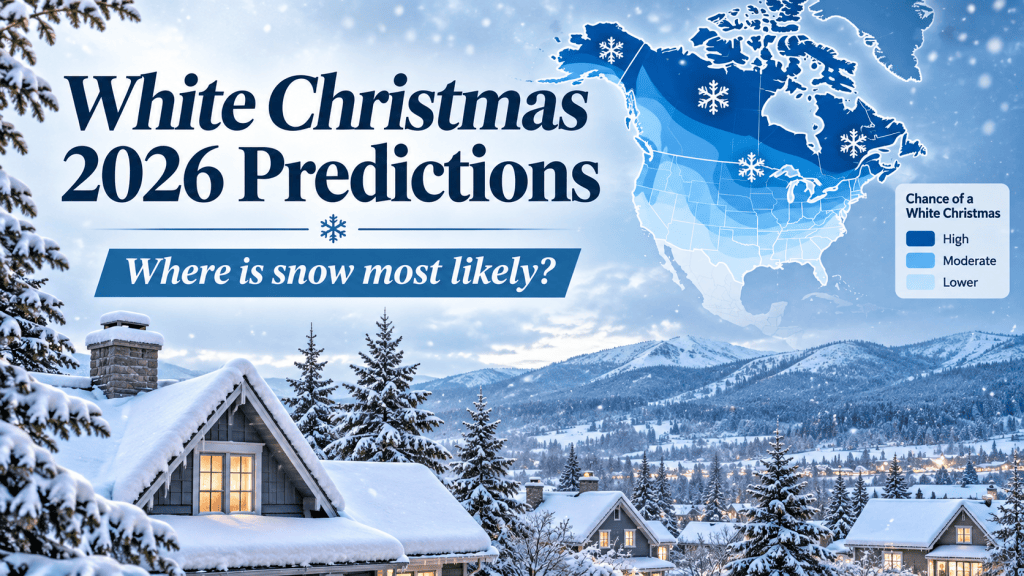
Will Christmas 2026 be white? For many families in the United States and Canada, snow on Christmas morning is part of the holiday dream. But predictions made in early November deserve caution: an exact forecast for December 25 is still too far away to trust.
The better starting point is historical data. NOAA tracks where snow is commonly on the ground at Christmas in the U.S., while Environment and Climate Change Canada publishes 70 years of Christmas snow statistics for Canadian cities. Those records help answer where a white Christmas is usually more likely, even though they cannot predict this year’s weather.
Quick answer: Northern and high-elevation U.S. locations historically have better odds of snow cover at Christmas. In Canada, Winnipeg, Ottawa and Montreal have substantially higher historical white Christmas rates than Toronto or Vancouver. For a real 2026 forecast, check local weather services during the week before December 25.
What Counts as a White Christmas?
Definitions differ slightly across the border, and neither requires snow to be falling all day.
- United States: NOAA’s white Christmas map uses at least 1 inch (2.54 cm) of snow on the ground on December 25.
- Canada: Environment and Climate Change Canada counts a white Christmas when at least 2 cm of snow covers the ground on Christmas morning. It separately defines a “perfect Christmas” as that snow cover plus measurable snowfall during Christmas Day.
A city can have a white Christmas under either definition even when the sky is clear: snow from earlier storms may remain on the ground.
White Christmas Odds in Canadian Cities
Canada’s official historical Christmas snowfall table covers 1955–2024 for most locations. The percentages below refer to the share of Christmas mornings that met Canada’s snow-cover definition over that period. They are not probabilities specifically calculated for Christmas 2026.
| City | Historical white Christmas rate (1955–2024) |
|---|---|
| Winnipeg | 99% |
| Quebec City | 97% |
| Edmonton | 87% |
| Ottawa | 79% |
| Montreal | 74% |
| Calgary | 61% |
| Halifax | 51% |
| Toronto City | 44% |
| Windsor | 43% |
| Vancouver | 10% |
Source: Environment and Climate Change Canada — Historical Christmas Snowfall Data. The agency also reports separate statistics for the more recent 2000–2024 period, which can differ from these longer-term averages.
What Do the Numbers Actually Tell Us?
Winnipeg’s 99% historical rate suggests snow cover at Christmas has been highly consistent. Vancouver’s 10% means it has usually experienced a snow-free Christmas morning under Canada’s definition. Toronto and Windsor sit closer to the middle: both have seen a mix of snowy and snow-free Christmases.
Historical rates are useful for general expectations and travel planning, but a high historical rate is not a guarantee. A warm spell or an unusual storm track can change conditions in any individual year.
Where Is Snow Most Likely in the United States?
NOAA’s map, based on the 1991–2020 U.S. Climate Normals, identifies several regions where at least one inch of snow on the ground is historically more common around Christmas. These include:
- Minnesota and parts of the northern Great Lakes region
- Maine and upstate New York
- The Rocky Mountains and Sierra Nevada
- Higher elevations in Idaho
- Parts of the Allegheny Mountains in Pennsylvania and West Virginia
Meanwhile, the Gulf Coast, Deep South and many lower-elevation West Coast locations have much lower historical probabilities of a snow-covered Christmas.
The map is not a 2026 forecast; it summarizes weather observed over many years. Use NOAA’s White Christmas guide or its interactive historical map to explore areas near your destination.
Can We Predict Christmas 2026 Weather in November?
Not reliably for one city on one date. Seasonal outlooks may describe broad probabilities for temperatures or precipitation over a month or an entire season. They do not say with confidence whether snow will be on the ground at a particular address on December 25.
For example, a colder-than-average December can still include dry weeks. And a city experiencing a relatively mild winter can still receive snow just before Christmas. Snow cover depends on both precipitation and whether temperatures allow the snow to remain.
When Should You Check the Actual Christmas Forecast?
Environment and Climate Change Canada publishes a seven-day local forecast, meaning December 19, 2026 is the first day its standard seven-day window reaches December 25. U.S. readers can also check the National Weather Service as Christmas approaches.
| When | Best information available |
|---|---|
| Early November | Historical snow-cover rates; broad seasonal outlooks |
| Early to mid-December | Updated climate trends, but limited day-specific certainty |
| December 19 onward | Canadian seven-day local forecast including Christmas Day |
| December 23–24 | Short-range forecasts useful for final travel and holiday plans |
Even short-range forecasts can change. If weather affects travel, check official warnings and road conditions rather than relying on one forecast screenshot.
How to Check for Snow in Your City
- In the United States: Visit weather.gov, enter your city or ZIP code, and check the local forecast as the holiday approaches.
- In Canada: Open Environment and Climate Change Canada’s weather service, search your location, and check the seven-day forecast.
- Look for snow cover, not only snowfall: A forecast of no snow on December 25 does not necessarily mean the ground will be bare.
- If traveling: Check both your destination and the route, especially where freezing rain or mountain conditions may be involved.
White Christmas 2026: Frequently Asked Questions
Which U.S. states have the best historical odds?
NOAA highlights northern states and higher elevations, including Minnesota, Maine, parts of New York, Idaho and the major western mountain ranges. The odds vary considerably within each state.
Which Canadian cities have the best historical odds?
In Environment and Climate Change Canada’s historical table, cities such as Winnipeg (99%), Quebec City (97%) and Edmonton (87%) have high long-term white Christmas rates. These are historical observations, not 2026 forecasts.
Does it have to snow on Christmas Day?
No. A white Christmas is generally defined by snow already on the ground. Canada also tracks a stricter “perfect Christmas” category that includes snow falling that day.
Could an El Niño or La Niña year decide whether Christmas is white?
Large-scale climate patterns can influence seasonal temperatures and precipitation, but they do not reliably determine conditions on December 25 in an individual city. Local weather forecasts matter more close to the date.
When will Christmas 2026 weather predictions become useful?
Check official local forecasts within roughly a week of the holiday and review them again in the final two or three days.
The Bottom Line
If you’re dreaming of a white Christmas in 2026, historical snow data can show where your chances have generally been better, but it cannot promise snow this year. Winnipeg and other northern Canadian cities have strong historical records, while Vancouver and many southern U.S. locations have much lower rates. For the actual December 25 outlook, follow official local forecasts during Christmas week.
Sources and Methodology
- NOAA — What Are Your Chances for a White Christmas? (1991–2020 U.S. Climate Normals).
- NOAA Climate.gov — Interactive White Christmas Map.
- Environment and Climate Change Canada — Historical Christmas Snowfall Data (1955–2024).
- U.S. National Weather Service and Environment and Climate Change Canada Weather for current local forecasts.
Updated November 2, 2026. This guide separates historical snow-cover probabilities from short-range weather forecasts. The featured artwork is an illustrative design, not a meteorological forecast map.

