
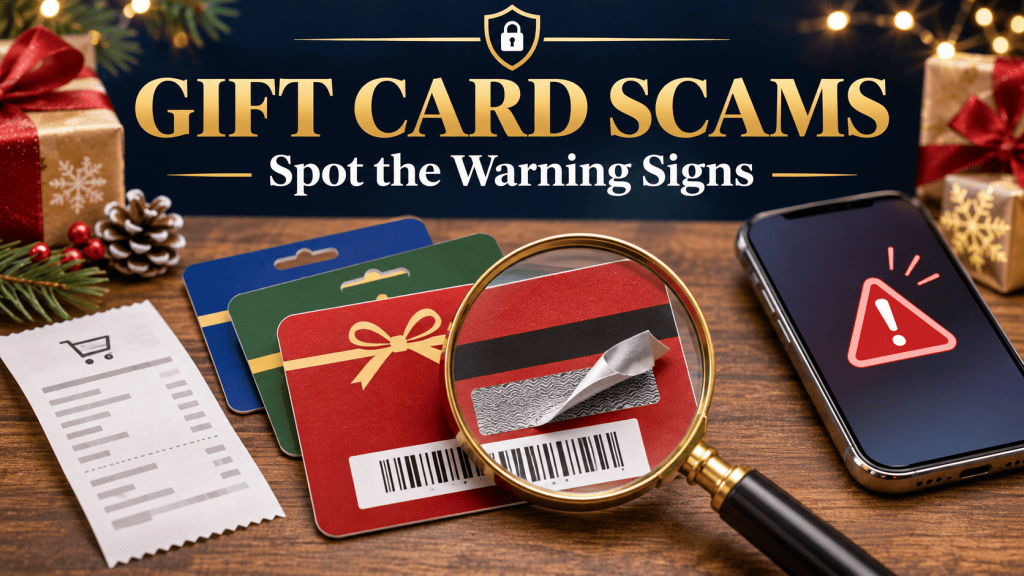
Updated November 6, 2026. Gift cards make convenient holiday presents, but a card that looks perfectly normal can have its balance stolen before the recipient uses it. Scammers also impersonate businesses or government agencies and demand gift card codes as payment. This guide explains the difference, how to check a card before buying, and what to do if money disappears.
The practical advice below is based on published consumer guidance from the U.S. Federal Trade Commission (FTC), the Canadian government and the Competition Bureau. These are prevention tips, not a guarantee of recovering lost funds.
Two different gift card scams to recognize
1. Gift card tampering at a store
A criminal may copy the card number and PIN or remove a security sticker from a card on a display rack, then wait for a legitimate shopper to load money onto it. The scammer can redeem the balance without ever holding the purchased card. The FTC’s gift card inspection warning specifically recommends checking packaging and protective stickers before purchase.
2. Someone demands payment using a gift card
A caller, text message or email may claim to be from a government office, a utility company, a tech-support service or even a relative in trouble. They tell you to buy a gift card and send a photo of the code or PIN. The FTC’s gift card scam guide is unequivocal: gift cards are for gifts, not for paying unexpected bills or fines. An urgent demand to share codes is a major fraud warning.
How to check a physical gift card before paying
- Inspect the protective strip. Look for peeling, scratches, replacement stickers or an exposed PIN. Do not purchase a card that looks altered.
- Check the packaging. Compare seals, card numbers visible through windows and other security features with nearby cards. Damage is a reason to ask store staff for another card.
- Buy from a familiar retailer. Avoid auction listings and heavily discounted gift cards from unknown resellers; their legitimacy can be hard to verify.
- Keep the activation receipt. Save a photo of the receipt and card details in a secure place; do not share the PIN publicly.
- Verify activation. If the cashier supplies a separate activation slip, check that it matches the card purchased. Follow the issuer’s official balance-checking instructions.
A card without obvious damage is not guaranteed to be safe. The point is to reduce risk and retain proof of purchase if something goes wrong.
How to check a digital gift card
- Open the retailer’s official website or app yourself instead of following a sponsored social-media link or unsolicited message.
- Confirm the website address carefully. Fraudulent sites may imitate legitimate brands with altered spellings.
- Review the card’s permitted country, currency, expiration terms, redemption restrictions and refund policy before purchase.
- Send digital cards only through a trusted delivery method and verify the recipient’s email address.
- Keep the original confirmation email and order number. Never post the gift card number or redemption code on social media.
The Canadian government’s online shopping guide recommends checking seller contact details, terms of sale, and return or complaint procedures before buying. The Competition Bureau’s merchandise scam guide warns that fake storefronts and unusually cheap offers can be used to lure shoppers.
Warning signs that a gift card request is a scam
- Someone says you must buy a gift card immediately to avoid arrest, service cancellation or a penalty.
- A supposed employer or manager asks you to buy gift cards and send the numbers privately.
- A stranger offers a suspiciously cheap gift card and insists on moving the transaction outside a trusted marketplace.
- A caller asks you to read or photograph the PIN, scratch-off code or full card number.
- A message impersonating a friend or family member uses urgency and discourages you from independently calling that person.
Do not assume a familiar voice or display name proves the request is real. Hang up or stop messaging, then contact the person or organization using a phone number or website you already trust.
What to do if a gift card balance is missing
Act quickly. Recovery is not guaranteed, but early reporting may help.
- Contact the gift card issuer using the official support information on its website or the card packaging. Explain the suspected fraud and ask whether the balance can be frozen or investigated.
- Keep the card, receipt, activation slip, transaction date, screenshots and any messages from the scammer.
- If you paid by credit card, contact your card issuer to ask whether a dispute is appropriate. Eligibility and outcomes vary; a dispute is not automatic reimbursement.
- If you shared account credentials or payment details on a fake site, change the affected passwords, enable multi-factor authentication and notify the relevant financial provider.
- Report the incident to the appropriate national fraud-reporting service and, where warranted, local police.
Where to report gift card fraud in the United States
The FTC accepts reports through ReportFraud.ftc.gov. Its gift card scam resource explains how to contact issuers and request help. Report the incident even if you are unsure whether the balance can be recovered.
Where to report gift card fraud in Canada
The Canadian Anti-Fraud Centre collects reports of fraud and identity theft. The Government of Canada advises reporting suspected fraud even if you were not personally victimized; see its fraud and scam reporting guidance. If personal or financial information was exposed, contact the affected institutions promptly.
Are gift cards safer than cash or credit cards?
For a gift recipient, a card can be useful because it limits spending to a particular retailer or service. But it is generally a poor choice for paying someone you do not know: gift card value can be redeemed quickly and transactions may be difficult to reverse. When shopping online, the FTC advises using a credit card when possible because qualifying billing problems may be disputed under applicable rules. Protections depend on the transaction and jurisdiction.
Frequently asked questions
Can a sealed gift card already be compromised?
Yes. Some tampering is subtle, so an intact-looking package cannot guarantee that a card is safe. Buy from trustworthy sellers, inspect the card and keep your receipt.
Can scammers steal a gift card without physically taking it?
Yes. If someone has the card number and PIN, they may be able to spend the balance remotely after activation.
Will a store always refund a stolen gift card balance?
No. Issuers and retailers have different policies, and reimbursement is not guaranteed. Report the problem immediately with the original purchase documentation.
Is a gift card requested by a government office ever legitimate?
A demand from someone claiming to represent a government office to settle an urgent bill or penalty with a retail gift card is a strong scam indicator. Verify the matter independently through official government contact channels.
Should I buy discounted gift cards from strangers?
That carries additional risk of fake, stolen or previously redeemed cards. If a discount looks unusually generous, independently verify the seller and consider buying directly from the issuer instead.
Quick holiday gift card safety checklist
- Buy from the retailer or a reputable authorized seller.
- Inspect physical cards for damaged or replaced security strips.
- Never send gift card codes to anyone demanding payment.
- Keep your receipt and activation information.
- Verify digital card addresses and recipient details.
- Contact the issuer and report suspected fraud without delay.
Sources and further reading
- FTC — Check out gift cards before you buy them (December 2024)
- FTC — Avoiding and reporting gift card scams
- FTC — How to avoid online shopping scams (November 2025)
- Government of Canada — Online shopping safety
- Competition Bureau Canada — Purchase of merchandise scams
- Canadian Anti-Fraud Centre — Reporting

