Last updated: October 30, 2026
If you recently activated a cellphone plan or switched wireless providers in Canada, check your bill. You may have been charged a fee that is no longer permitted under federal telecommunications rules.
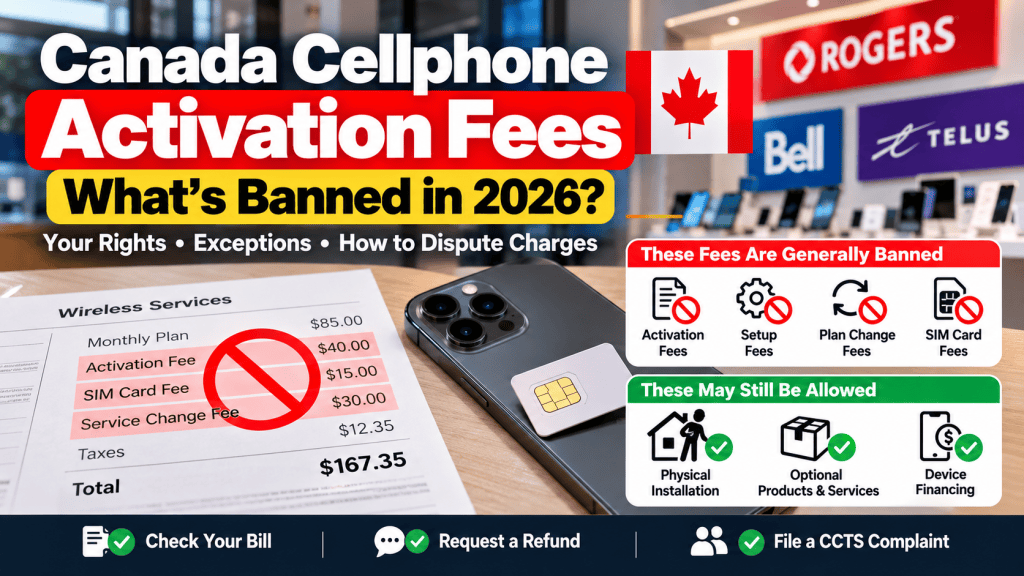
As of June 12, 2026, new Canadian Radio-television and Telecommunications Commission (CRTC) rules prohibit certain fees for activating cellphone and internet plans or modifying existing services.
The changes are intended to make switching providers and changing plans easier and more affordable.
However, there is an important catch: not every setup, installation, SIM card, or device-related fee is automatically prohibited.
Rogers, Bell, and TELUS have also faced regulatory scrutiny over certain charges introduced around the time the new rules took effect.
Here’s what the rules actually say, which fees may still be allowed, and how to dispute a charge on your bill.
Quick Answer: Are Cellphone Activation Fees Banned in Canada?
Yes. For covered services, the CRTC’s prohibition on activation and modification fees took effect on June 12, 2026.
The rules generally prohibit charges that arise simply from activating a new service plan or modifying an existing one.
Examples include:
- New account activation fees
- Wireless service connection fees
- Enrollment or service setup fees
- Charges for changing an existing cellphone plan
- Internet speed-change fees that don’t require physical installation
- Installation fees where no technician needs to visit the premises
However, two major exceptions remain.
Providers may charge reasonable fees for physical service installation at a customer’s premises or for additional products and services the customer explicitly chooses to purchase.
These protections are established under Telecom Regulatory Policy CRTC 2026-43.
Who Is Protected by the New CRTC Rules?
The updated rules apply to:
- Individual customers of Canadian mobile wireless service providers
- Small-business customers of mobile wireless service providers
- Individual home internet customers whose providers are subject to the Internet Code
This means the changes are not limited to customers of the three largest telecom companies.
However, the CRTC has not extended the amended Internet Code protections to every type of business internet arrangement.
Customers with specialized business services should confirm which protections apply to their contracts.
Which Cellphone and Internet Fees Are No Longer Allowed?
The distinction between activating a service and purchasing an additional product is important.
The following examples reflect how the CRTC and the Commission for Complaints for Telecom-television Services (CCTS) explain the rules.
| Type of Charge | General Treatment Under the Rules |
|---|---|
| New wireless plan activation fee | Generally prohibited |
| New account setup fee | Generally prohibited |
| Service connection fee | Generally prohibited |
| Existing wireless plan-change fee | Generally prohibited |
| Internet speed-change fee without physical installation | Generally prohibited |
| Fee to activate an internet plan without a technician visit | Generally prohibited |
| Reasonable physical installation at the customer’s premises | May be allowed |
| Explicitly selected optional product or service | May be allowed |
| Device financing balance | Separate contractual obligation |
| Certain SIM, device-handling, or shipping fees | Subject to further regulatory scrutiny |
The name of a charge does not always determine whether it is permitted.
What matters is why the fee was imposed and whether it falls within the CRTC’s rules and exceptions.
What Fees Can Providers Still Charge?
The new rules do not make every telecommunications-related fee illegal.
1. Physical Installation Fees
A reasonable installation charge may be permitted when a technician physically installs a service or required equipment at your home or other premises.
For example, an internet provider might need to send a technician to complete physical installation work.
That situation is different from activating a plan remotely without a technician visit.
2. Optional Products and Services
Providers may charge for additional products or services you explicitly agree to purchase.
Examples may include an optional home Wi-Fi configuration service or extra equipment not required to deliver the telecommunications service.
The customer must actually choose the additional product or service.
3. Outstanding Device Payments
If you financed a smartphone through your provider, the remaining financing balance does not automatically disappear when you cancel or change your wireless service.
Device financing, device subsidies, and equipment return conditions may create separate contractual obligations.
4. Other Account-Related Charges
According to the CCTS, certain charges unrelated to activating or modifying a service plan may still be allowed.
Examples may include reconnection after non-payment, bill reprints, and equipment non-return charges.
Whether a particular charge is valid depends on the circumstances and applicable contract terms.
Rogers, Bell and TELUS: Why Are Some Fees Under Investigation?
Following the new rules, the CRTC raised concerns about charges introduced or maintained by Canada’s major telecommunications providers.
On June 30, 2026, the regulator launched a proceeding requiring Bell, TELUS, and Rogers to explain why certain fees should be considered compliant.
Importantly, the start of a compliance proceeding does not mean that every disputed charge has already been ruled unlawful.
Here are the specific charges identified in that proceeding.
Bell: $40 Device-Handling Charge
The CRTC raised concerns about a $40 device-handling fee associated with cellphone purchases.
Bell argued that purchasing a device was optional and that the charge related to fulfilling a separate device purchase rather than activating a wireless plan.
The regulator initiated further review of that position.
TELUS: $15 SIM and eSIM Charges
The CRTC also questioned TELUS’ $15 charge for physical SIM cards and eSIMs.
The regulator noted that a SIM or eSIM may be necessary to deliver the wireless service, raising questions about whether such a fee qualifies as a genuinely optional purchase.
TELUS argued that SIM cards can also be purchased independently for purposes unrelated to new service activation.
Rogers: Device Setup, Shipping and SIM Fees
Rogers identified several charges in correspondence with the regulator:
| Charge | Amount or Description |
|---|---|
| Device setup | $40 |
| Shipping for devices ordered online | $25 |
| SIM-related fee | Amount not specified in the proceeding |
Rogers maintained that its device setup and shipping charges were tied to additional services or device purchases rather than prohibited plan activation or modification fees.
What Is the Current Regulatory Status?
As of October 30, 2026, the latest procedural determination identified in the official materials reviewed for this guide was issued on August 14, 2026.
That determination adjusted the proceeding’s deadlines, with interventions due August 31 and replies due September 10.
A final ruling on the disputed charges was not established by the materials reviewed for this article.
Customers should therefore avoid assuming that all identified fees have already been definitively prohibited or approved.
The relevant proceeding is CRTC 2026-155.
How to Check Your Cellphone Bill for Prohibited Fees
You don’t need specialized knowledge to begin reviewing your bill.
Follow these steps.
Step 1: Find the Date of the Charge
Locate the invoice covering your activation or plan change.
Check whether the disputed fee was charged on or after June 12, 2026.
Charges from earlier periods may be subject to different rules.
Step 2: Identify the Fee Description
Look for terms such as:
- Activation
- Connection
- Setup
- Enrollment
- Plan modification
- Service adjustment
- Device handling
- SIM or eSIM
- Shipping
Write down the exact description and amount.
Step 3: Review Your Agreement
Check the service agreement, order confirmation, and any documents you received when signing up.
Look for evidence that you expressly agreed to purchase an optional product or service.
If you activated a plan online and did not request any additional products, that may be relevant to your dispute.
Step 4: Determine Whether Physical Installation Was Required
Consider whether a technician physically installed the service at your premises.
For internet services, a legitimate installation visit may fall within an exception.
For a routine wireless plan activation that did not involve physical installation at your premises, that particular exception may not apply.
Step 5: Save Your Evidence
Keep copies of:
- Your bill showing the charge
- Your service agreement
- Order confirmation emails
- Screenshots of advertised offers
- Customer service correspondence
- Any explanation provided by your carrier
Having this information ready will make it easier to explain your concerns.
How to Dispute an Activation Fee With Rogers, Bell or TELUS
If you believe a charge is prohibited, contact your service provider first.
The CCTS recommends giving the provider an opportunity to investigate and resolve the dispute before submitting a complaint.
You can use the following message as a starting point.
Sample Message to Your Provider
Subject: Request for Review of Activation or Setup Fee
Hello,
I recently reviewed my telecommunications bill and noticed a charge of $[amount], described as “[fee description],” dated [date].
I understand that Telecom Regulatory Policy CRTC 2026-43 introduced protections against certain activation and modification fees effective June 12, 2026.
Could you please review this charge and explain whether it is permitted under the current CRTC rules?
If this charge falls within the prohibited categories, I would appreciate a reversal or refund.
If you believe the charge qualifies for an exception, please identify the applicable exception and explain how it applies to my service.
Thank you for reviewing this matter.
Kind regards,
[Your Name]
What Should You Do If the Provider Refuses?
Ask the representative to explain why the charge is permitted.
Request a written explanation or save a transcript of the conversation.
Record the date of the interaction and any reference number provided.
If the provider does not resolve the matter, you may be able to submit a complaint to the CCTS.
How to File a Complaint With the CCTS
The Commission for Complaints for Telecom-television Services is an independent organization that helps resolve eligible disputes between customers and telecommunications providers.
Its services are free to consumers.
Before submitting a complaint, you must first attempt to resolve the matter directly with your provider.
Step 1: Visit the CCTS Website
Open the official complaints page:
File a Telecom Complaint With the CCTS
Step 2: Describe the Disputed Charge
Include the exact fee description, amount, date, and why you believe it may conflict with the CRTC’s rules.
Step 3: Provide Supporting Information
Provide relevant bills, contracts, and communication records.
Step 4: Follow the Complaint Process
The CCTS will assess whether the complaint falls within its mandate.
If accepted, it can work with you and the provider to investigate and seek a resolution.
Be aware that complaints involving the particular Rogers, Bell, and TELUS fees already under CRTC review may be subject to a pause in substantive dispute-resolution activities while the regulator considers those charges.
Do You Still Have to Pay Your Bill?
The CCTS advises customers to continue paying charges they are not disputing.
For example, if you’re contesting a $30 activation charge on a $100 bill, you should continue paying the undisputed portion.
The treatment of the contested amount can depend on the complaint process and outcome.
If the CCTS determines that the charge was allowed, you may still be responsible for it.
For this reason, don’t assume you can simply ignore an entire bill while a dispute is underway.
Can You Cancel a Canadian Cellphone Plan Without Paying a Fee?
The updated CRTC rules also changed the Wireless Code’s treatment of early cancellation charges.
When a subsidized device was not provided as part of the wireless contract, the provider must not charge an early cancellation fee.
However, this does not eliminate every outstanding financial obligation.
For example, if you have an unpaid device financing balance, that obligation may still need to be settled.
A contract involving a subsidized device can also have different cancellation conditions.
Home internet cancellation terms may differ, particularly for fixed-term contracts.
Before switching providers, check your agreement and request a breakdown of any remaining charges.
How Much Could These Rules Save You?
The amount depends on the fee that would otherwise have applied.
Consider a household activating three cellphone lines.
| Hypothetical Fee Per Line | Three Lines |
|---|---|
| $30 | $90 |
| $40 | $120 |
| $50 | $150 |
| $70 | $210 |
These are illustrative calculations, not a claim that these fees are currently charged by any particular provider.
If an applicable activation fee is prohibited, avoiding it on multiple lines could save a household a meaningful amount.
Customers who switch plans frequently may also benefit from the removal of certain modification fees.
However, the rules do not guarantee that a particular monthly plan is cheaper.
Always compare the total cost of the service, including taxes, equipment charges, discounts, and financing obligations.
Frequently Asked Questions
Are cellphone activation fees illegal in Canada in 2026?
Certain activation and modification fees are prohibited for covered wireless and internet services starting June 12, 2026. Exceptions apply, including reasonable physical installation charges and explicitly selected optional products or services.
Does the new rule apply to Rogers, Bell and TELUS?
The amended Wireless Code applies to wireless providers, including the major carriers. However, the regulatory treatment of certain device-related and SIM-related charges has been under separate review.
Can a provider charge me to change my cellphone plan?
A routine service plan modification fee is generally prohibited under the updated rules. Charges for qualifying optional services or other legitimate contractual obligations may be treated differently.
Are SIM card and eSIM fees banned?
Not every SIM-related transaction has been conclusively addressed by the general prohibition. Specific SIM and eSIM charges have been examined in a separate CRTC proceeding.
Can I request a refund for a fee charged after June 12, 2026?
You can request a review and reversal if you believe the charge was prohibited. Whether a refund is required depends on the circumstances and the applicable rules.
Does the rule apply to internet activation fees?
Yes, the amended Internet Code protects individual home internet customers of providers subject to that code. The scope is not identical to the wireless rules for every business customer.
Where can I complain about an activation fee?
Contact your provider first. If the dispute remains unresolved, visit the CCTS website to determine whether your complaint qualifies.
Final Thoughts: Always Review Your First Telecom Bill
Canada’s June 2026 CRTC rules provide meaningful new protections for cellphone and internet customers.
If you’re activating a new service or changing providers, you generally should not have to pay a prohibited activation or modification fee.
However, legitimate installation charges, optional services, and outstanding equipment obligations may still apply.
The most effective approach is to review your agreement, check your first bill, and ask your provider to explain any unexpected charge.
If the explanation doesn’t address your concerns, the CCTS provides an independent complaint process.
Before paying an unfamiliar setup charge, take a few minutes to find out exactly what it’s for.
Official Sources and References
- CRTC — Telecom Regulatory Policy 2026-43: Prohibition of Fees That Are a Barrier to Switching Plans — March 12, 2026.
- CRTC — Telecom Notice of Consultation 2026-155: Compliance Proceeding — June 30, 2026.
- CRTC — Telecom Notice of Consultation 2026-155-2: Procedural Update — August 14, 2026.
- CCTS — New Rules: What Fees Can Internet and Wireless Phone Providers Charge? — September 2, 2026.
- CCTS — File a Telecom Complaint
- CRTC — The Wireless Code, Simplified
Disclaimer: This article provides general information about Canadian telecommunications consumer protections and is not legal advice. Regulatory proceedings, individual contract conditions, and applicable rules may change. Consult the CRTC, CCTS, or your provider for current details.

