Last updated: October 29, 2026
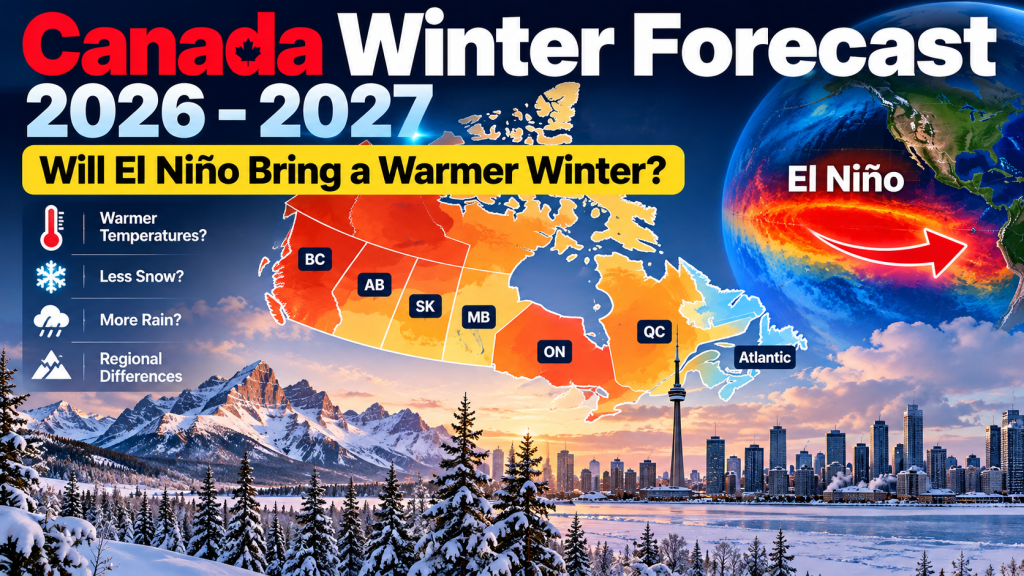
Canada could experience an unusually mild winter in 2026–2027 as one of the strongest El Niño events in recent history develops in the Pacific Ocean.
According to the latest information from the National Oceanic and Atmospheric Administration (NOAA) and Environment and Climate Change Canada (ECCC), above-normal winter temperatures are increasingly likely across much of the country.
But does that mean less snow, fewer winter storms, and a shorter winter?
Not necessarily.
Even an exceptionally strong El Niño cannot guarantee mild weather every day, and some Canadian regions could still face significant snowstorms, freezing rain, and extreme cold.
Here’s what the official forecasts say about Canada’s upcoming winter, including expectations for Ontario, British Columbia, Alberta, Quebec, and Atlantic Canada.
What Is the Latest Canada Winter Forecast for 2026–2027?
The overall outlook currently favours a warmer-than-normal winter across large portions of Canada.
Environment and Climate Change Canada’s seasonal forecasting system indicates an increased probability of above-normal average temperatures in many Canadian cities during November 2026 through January 2027.
The forecast is consistent with the development of an exceptionally strong El Niño event.
On October 8, 2026, NOAA maintained its El Niño Advisory and reported that El Niño was continuing to strengthen.
The agency indicated a greater than 83% chance of strong-to-very-strong El Niño conditions persisting through January–March 2027.
NOAA also estimated an 83% chance that the October–December 2026 El Niño would exceed the strength of previous events in its historical record, based on its specified Relative Oceanic Niño Index threshold.
Important: That 83% figure refers to the expected strength of El Niño, not the probability that an individual Canadian city will experience a warmer winter.
Seasonal weather outcomes vary significantly by region.
Canada Winter 2026–2027: Forecast by Region
The following summary combines historical El Niño patterns with currently available Canadian seasonal forecasting information.
| Region | Temperature Outlook | Main Considerations |
|---|---|---|
| British Columbia | Warmer than normal favoured | Potentially reduced mountain snowpack; regional rain and flood risks |
| Alberta | Warmer than normal favoured | Milder seasonal averages, but cold outbreaks remain possible |
| Saskatchewan & Manitoba | Warmer than normal favoured | Possible reduced precipitation in some areas |
| Ontario | Warmer than normal favoured | Rain, freezing rain, and winter storms remain possible |
| Quebec | Warmer than normal favoured | Variable snow and freezing-rain conditions |
| Atlantic Canada | Warmer than normal favoured | Coastal storms and precipitation remain concerns |
| Northern Canada | Significant regional variation | Temperature, ice, and storm risks differ by location |
These are broad seasonal tendencies rather than daily forecasts.
Let’s examine the regions more closely.
Ontario Winter Forecast 2026–2027: Will Toronto and Ottawa Be Warmer?
Ontario is among the regions currently forecast to experience above-normal average temperatures during the November–January period.
Environment Canada’s October 1 seasonal outlook indicates that Toronto, Ottawa, and Windsor each have approximately a 70–79% modelled probability of above-normal temperatures during November 2026 through January 2027.
However, the forecast system assigns low historical prediction skill to those locations for that outlook.
That means the percentage should not be interpreted as a guarantee.
Does a Warmer Ontario Winter Mean Less Snow?
Not necessarily.
A warmer seasonal average could mean more periods when precipitation falls as rain rather than snow.
But winter storms can still deliver significant snowfall when temperatures and atmospheric conditions align.
Some areas around the Great Lakes can also experience lake-effect snow under suitable conditions.
Freezing rain is another important concern, especially when temperatures fluctuate around freezing.
For Ontario residents, the best approach is to prepare for a potentially milder overall winter without assuming snowstorms or icy roads will disappear.
Alberta Winter Forecast 2026–2027: Calgary and Edmonton
Alberta is another province where above-normal seasonal temperatures are favoured.
Environment Canada’s October outlook gives Calgary a 70–79% modelled probability of above-normal temperatures for November through January, with historical forecast skill of 49%.
Edmonton International Airport also falls within the 70–79% above-normal probability range.
What Does El Niño Usually Mean for Alberta?
El Niño is often associated with milder and drier conditions in parts of western and central Canada.
For Alberta, this could translate into warmer seasonal averages and potentially reduced precipitation in some locations.
However, Calgary and Edmonton can still experience sudden temperature changes, periods of severe cold, and snowstorms.
A warmer-than-normal winter does not necessarily mean fewer individual days of hazardous weather.
What About the Rocky Mountains?
Mountain snowpack is particularly important for western Canada.
Historical El Niño events have sometimes produced lower snowfall totals and reduced snowpack in parts of the Rockies.
This can affect ski conditions, spring runoff, and water availability.
However, ski resorts and individual mountain regions may experience different results depending on elevation and local storm patterns.
Anyone planning winter sports should follow resort-specific snow reports rather than assuming the entire season will be poor.
British Columbia Winter Forecast: Vancouver, Victoria and the Interior
British Columbia has a relatively strong historical relationship with El Niño.
Environment Canada’s October outlook favours above-normal November–January temperatures in Vancouver and Victoria, with modelled probabilities in the 80–89% range.
The Interior also shows a broad tendency toward warmer seasonal conditions.
Will Vancouver Have a Snow-Free Winter?
There is no reliable basis for guaranteeing a snow-free winter.
Vancouver already experiences a relatively mild coastal climate compared with much of Canada.
Even in an El Niño winter, short cold outbreaks can produce snowfall at lower elevations.
British Columbia may also face important precipitation risks.
Although some western regions tend to be drier during El Niño, certain coastal locations can experience heavy rain, flooding, or landslides.
Lower mountain snowpack could also affect water conditions later in 2027.
For homeowners, checking drainage systems and preparing for heavy rainfall remains important.
Quebec and Atlantic Canada: What to Expect
The influence of El Niño is generally less consistent in eastern Canada than in western regions.
However, the current Canadian seasonal outlook favours above-normal temperatures across many eastern locations.
Environment Canada’s October forecast indicates that Montréal-area stations have modelled above-normal temperature probabilities of 80–89% for November through January.
Quebec
Quebec may experience periods of milder winter weather, but significant snowfall and freezing rain remain possible.
Temperature fluctuations can create hazardous road and sidewalk conditions.
Atlantic Canada
New Brunswick, Nova Scotia, Prince Edward Island, and Newfoundland and Labrador could also experience a milder seasonal average.
However, Atlantic winter storms remain an important concern.
Coastal communities should continue monitoring official weather warnings for strong winds, heavy precipitation, coastal flooding, and storm surges.
Will Canada Get Less Snow in Winter 2026–2027?
This is one of the biggest questions surrounding the upcoming winter.
Historically, strong El Niño events have often been associated with reduced snowfall in parts of western and central Canada.
However, snowfall depends on more than seasonal temperature averages.
Several factors influence how much snow an area receives:
- Local temperature during precipitation
- Storm tracks and atmospheric circulation
- Available moisture
- Elevation and geography
- Lake-effect snowfall near the Great Lakes
A warmer winter can still produce major snowstorms.
For example, a city could experience several mild weeks followed by a powerful winter storm.
That city might finish the season warmer than average while still receiving substantial snowfall.
The bottom line: El Niño increases the likelihood of certain seasonal patterns, but it cannot reliably predict exact snowfall totals for individual Canadian cities months in advance.
What Is a “Super” or “Godzilla” El Niño?
You may have seen headlines describing the developing event as a “Super El Niño” or “Godzilla El Niño.”
These dramatic terms generally refer to unusually strong El Niño conditions.
However, they are not separate official weather alert categories.
Scientists measure El Niño using changes in sea surface temperature and atmospheric conditions across the tropical Pacific.
NOAA’s October 8 forecast indicates a high probability of an event reaching historically exceptional strength.
But an exceptionally strong El Niño doesn’t mean every region will experience extreme weather.
It changes the probabilities of certain patterns rather than determining individual weather events.
Does a Warm Winter Mean Lower Heating Bills?
Possibly, but it isn’t guaranteed.
Warmer seasonal temperatures can reduce heating demand, particularly in homes heated by natural gas, electricity, or heating oil.
However, actual utility bills depend on several factors:
- Energy prices and rate changes
- Home insulation and air sealing
- Thermostat settings
- Heating system efficiency
- Household energy consumption
- Individual cold-weather periods
Even if temperatures remain above historical averages, energy prices or higher consumption could offset potential savings.
Homeowners should focus on reducing unnecessary heat loss rather than relying on a mild winter to lower their bills.
How to Prepare for Winter 2026–2027
A potentially warmer winter doesn’t eliminate the need for winter maintenance.
Here are some practical steps to consider before temperatures fall.
1. Inspect Your Heating System
Schedule routine maintenance for your furnace, boiler, or heat pump.
Check filters and make sure your heating equipment is functioning properly.
2. Check Windows and Doors
Inspect weather stripping and seal obvious air leaks.
Reducing drafts can improve indoor comfort and reduce heating demand.
3. Prepare for Freezing Rain
Keep suitable ice-control materials available.
Ensure walkways and outdoor steps can be maintained safely during icy conditions.
4. Clear Gutters and Drainage Areas
Warmer periods can create rain-on-snow conditions and rapid melting.
Clear leaves and debris from gutters, downspouts, and accessible drainage areas.
Make sure water is directed away from your foundation.
5. Prepare Your Vehicle
Review tire condition and follow applicable provincial winter tire requirements.
Keep an emergency kit in your vehicle and monitor weather alerts before long trips.
6. Check Official Weather Alerts
Seasonal forecasts provide broad information about likely trends.
For immediate hazards, rely on short-term forecasts and weather warnings.
Environment Canada provides updated alerts through its website and WeatherCAN app.
How Accurate Are Seasonal Winter Forecasts?
Seasonal forecasts are different from regular daily weather predictions.
A short-term forecast attempts to predict conditions at specific times and locations.
A seasonal forecast estimates whether average temperatures or precipitation over a longer period are more likely to be above, near, or below normal.
For example, a forecast showing a 70–79% probability of above-normal temperatures is not predicting that 70–79% of winter days will be warm.
Instead, it estimates the likelihood that the average temperature over the specified three-month period will fall into the above-normal category.
Forecast confidence and historical prediction skill also vary by location.
That’s why Environment Canada’s seasonal forecast tables include information about prediction skill.
For the most accurate interpretation, readers should review both probability and forecast skill.
Where to Check Updated Canadian Winter Forecasts
For the latest information, use these official sources:
Environment and Climate Change Canada
Official Canadian Seasonal Forecasts
Canada’s seasonal forecasts are updated regularly and include temperature and precipitation outlooks.
NOAA Climate Prediction Center
Official ENSO Diagnostic Discussion
NOAA publishes updates about the development and expected strength of El Niño and La Niña.
ClimateData.ca
What the Developing Exceptional El Niño Means for Canada in 2026–27
This Canadian climate science resource explains regional risks and historical patterns.
Frequently Asked Questions
Will Canada have a warm winter in 2026–2027?
Current official seasonal outlooks favour above-normal temperatures across much of Canada, particularly during November 2026 through January 2027. However, conditions will vary by region, and cold outbreaks remain possible.
Is El Niño confirmed for winter 2026–2027?
Yes. NOAA issued an El Niño Advisory on October 8, 2026, reporting that El Niño was already present and continuing to strengthen.
Will Ontario have less snow this winter?
Some areas could experience reduced snow cover or more precipitation falling as rain. However, exact seasonal snowfall totals cannot be reliably determined from El Niño strength alone.
Will Alberta experience a mild winter?
Above-normal average temperatures are currently favoured for Calgary and Edmonton during the November–January forecast period. Significant cold spells and snowfall remain possible.
Will Vancouver get snow this winter?
Snow remains possible in Vancouver despite the warmer-than-normal seasonal outlook. The current seasonal forecast does not predict exact snowfall days or totals.
When will the next winter forecast be released?
Environment Canada’s seasonal forecasts are updated monthly, with the next regular update expected in early November.
NOAA’s next scheduled ENSO Diagnostic Discussion is November 12, 2026.
Final Verdict: A Warmer Winter Is Favoured, but Don’t Put Away the Snow Shovel
Canada’s 2026–2027 winter is shaping up to be unusual.
A potentially historic El Niño is expected to influence temperatures and precipitation across the country.
The latest official forecasts favour milder-than-normal seasonal temperatures for many Canadian regions.
However, warmer seasonal averages do not eliminate snowstorms, freezing rain, extreme cold, or coastal weather hazards.
The smartest approach is to prepare for normal Canadian winter conditions while following updated regional forecasts.
For the latest information, check Environment Canada’s seasonal outlooks and local weather alerts as winter approaches.
Sources and References
- NOAA Climate Prediction Center — ENSO Diagnostic Discussion, October 8, 2026
- Environment Canada — Seasonal Temperature Forecast for November 2026–January 2027, Issued October 1
- Government of Canada — What Is El Niño and How Does It Affect Canada?
- ClimateData.ca — What the Developing Exceptional El Niño Means for Canada in 2026–27, August 21, 2026
- Environment Canada — Official Seasonal Forecast Portal
Editorial note: Seasonal forecasts describe probabilities rather than guaranteed weather outcomes. The information in this article reflects official releases available on October 29, 2026. Regional outlooks and climate projections are subject to change as new observations become available.

