Last updated: October 29, 2026
You might have seen a headline about contaminated butter, recalled cheese, or packaged food being removed from grocery store shelves.
But how do you know whether the food sitting in your refrigerator is actually affected?
Food recalls don’t always involve every package of a particular product. Sometimes, only specific production batches, expiration dates, or lot numbers are included.
Fortunately, both the United States and Canada provide free government databases that help consumers identify recalled products.
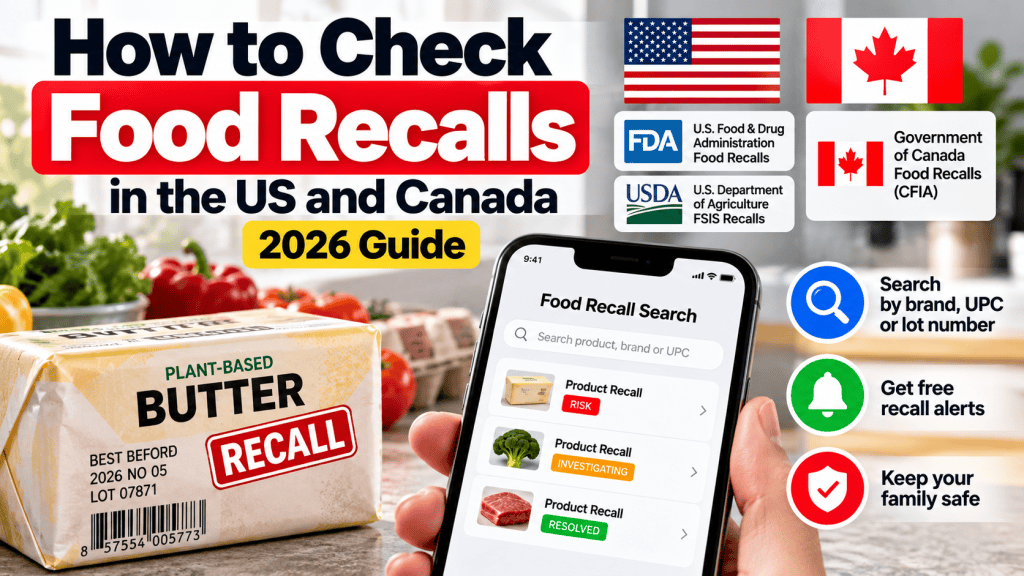
In this guide, you’ll learn how to check food recalls using official FDA, USDA, and Canadian government websites, identify affected products using UPC and lot codes, and sign up for free recall alerts.
Quick Answer: Where to Check Food Recalls
If you want to check a product immediately, start with the official website for your country.
| Country | Official Recall Database | Best For |
|---|---|---|
| United States | FDA Food Recalls | Most packaged foods, dairy, produce, and other FDA-regulated foods |
| United States | USDA FSIS Recalls | Meat, poultry, and processed egg products regulated by FSIS |
| United States | FoodSafety.gov | Viewing USDA and FDA recall alerts together |
| Canada | Canada Recalls and Safety Alerts | Canadian food recalls and other consumer safety alerts |
The important step is comparing your actual product information with the details in the official recall notice.
A matching brand name alone is not always enough.
How to Check FDA Food Recalls in the United States
The U.S. Food and Drug Administration (FDA) oversees recalls involving many types of food sold in the United States.
These include products such as:
- Dairy products and cheese
- Fruits and vegetables
- Packaged snacks
- Beverages
- Seafood
- Dietary supplements
- Many processed and packaged foods
Step 1: Open the FDA Recall Website
Visit the FDA’s food recall page.
The page provides information about food recalls, outbreaks, and safety alerts.
You can also use the FDA’s broader Recalls, Market Withdrawals, and Safety Alerts database.
Step 2: Find the Product
Search for the brand or product name using the available search and filtering tools.
For example, if you heard about a butter recall, search for the brand rather than assuming every product sold under that brand is affected.
Step 3: Read the Official Recall Details
Look for:
- Brand and product name
- Package size
- UPC or barcode number
- Lot or batch code
- Best-by or use-by date
- Distribution information
- Reason for recall
- Instructions for consumers
These details help determine whether your particular package is included.
Step 4: Compare the Notice With Your Food
Check the label on your package and compare all relevant identifiers.
If your product matches the recall notice, follow the official instructions and do not consume it.
If the information is incomplete or difficult to read, contact the manufacturer or retailer for clarification.
Important: Not every FDA-monitored recall appears as a public press release. If you cannot find a product in the announcements, you can also check the FDA Enforcement Reports, which provide additional recall records.
How to Check USDA Meat and Poultry Recalls
Not every food recall in the United States is handled by the FDA.
The U.S. Department of Agriculture’s Food Safety and Inspection Service (USDA FSIS) oversees recalls of meat, poultry, and certain egg products.
If you’re checking potentially recalled chicken, beef, turkey, or another FSIS-regulated food, use the USDA FSIS Recalls and Public Health Alerts page.
How to Identify an Affected USDA Product
USDA recall notices may include additional identifying information, such as an establishment number.
An establishment number is often printed inside or near a USDA inspection mark.
Compare the number, product description, package size, production date, and other identifiers listed in the notice.
For example, two packages of chicken with the same brand name could come from different production facilities.
One might be affected while the other is not.
That’s why checking the complete product description is important.
Is There One Website for Both FDA and USDA Recalls?
Yes.
FoodSafety.gov provides a consolidated resource for food recalls and outbreak information.
It’s a useful starting point if you’re unsure which federal agency regulates a particular food.
For detailed product identification, follow the notice to the responsible agency’s official information.
How to Check Food Recalls in Canada
Canadian consumers can use the Government of Canada’s national recalls and safety alerts database.
The Canadian Food Inspection Agency (CFIA) conducts food safety investigations, oversees food recalls, and helps keep consumers informed.
Step 1: Open the Canadian Recall Database
Visit recalls-rappels.canada.ca.
The website includes recalls for food, consumer products, vehicles, and health products.
Step 2: Search for a Food Product
Enter the food brand or product name.
Review the results and select the relevant food recall notice.
Check the publication date and any subsequent updates.
Step 3: Compare the Product Information
The CFIA advises consumers to compare the following details:
- Brand name
- Product name
- Package size
- Universal Product Code (UPC)
- Lot or batch number
- Other codes identified in the recall
If your product matches the affected identifiers, follow the recall instructions.
Step 4: Follow the Recall Instructions
If your product is recalled, the CFIA advises that you should not consume, serve, sell, or distribute it.
Instead, throw it away safely or return it to the place of purchase.
If you’re uncertain whether your food is included, contact the retailer for clarification.
How to Check Whether Your UPC or Lot Number Is Recalled
This is one of the most important parts of checking a food recall.
A recall notice may identify a particular product by several codes.
| Identifier | What It Tells You |
|---|---|
| Brand Name | Company or brand selling the product |
| Product Name | Specific food item |
| UPC | Barcode identifier used for a product |
| Lot or Batch Number | Identifies a particular production batch |
| Best-By Date | Manufacturer’s date marking |
| Package Size | Weight or quantity of the product |
| Establishment Number | Identifies a USDA-inspected facility, when applicable |
UPC vs. Lot Number: What’s the Difference?
A UPC identifies a retail product or product variation.
However, packages from different production batches can share the same UPC.
A lot number helps identify the particular manufacturing batch.
For example, imagine a manufacturer recalls only one batch of a particular cheese.
Two packages could have the same UPC but different lot numbers.
Only the affected production batch may be included in the recall.
This is why searching by UPC alone doesn’t always confirm whether a package is affected.
Where Can You Find the Lot Number?
Depending on the product, the lot number may appear:
- Near the best-by date
- On the bottom of a package
- Along the top or side seal
- On the back label
- On an outer carton
Some products use printed or stamped codes that can be difficult to read.
If you’re unsure which code applies, check the manufacturer’s information or contact the retailer.
What Do Class I, Class II, and Class III Food Recalls Mean?
The FDA uses recall classifications to describe the relative level of health risk associated with a recalled product.
| FDA Classification | General Meaning |
|---|---|
| Class I | Reasonable probability of serious adverse health consequences or death |
| Class II | Possible temporary or medically reversible health effects, or remote probability of serious effects |
| Class III | Exposure is not likely to cause adverse health consequences |
Class I represents the most serious classification.
However, you should not assume a recalled food is safe to eat simply because it has a lower classification.
Always follow the instructions in the specific recall notice.
Also remember that a company can initiate a recall before the FDA assigns its final classification.
An older recall may appear in news reports again when the FDA later classifies or updates it.
Recent Example: The October 2026 Plant-Based Butter Recall
A useful example is the Miyoko’s Creamery European Style Salted Plant Milk Butter recall reported in October 2026.
Prosperity Organic Foods initiated a voluntary recall on September 11, 2026, because of concerns involving yeast, mold, and E. coli.
The FDA classified the recall as Class II on October 23, 2026.
The affected product information reported from the FDA record included:
| Detail | Recalled Product |
|---|---|
| Brand | Miyoko’s Creamery |
| Product | European Style Salted Plant Milk Butter |
| Package | 8 oz |
| UPC | 857554005773 |
| Individual package lot | 07871 |
| Shipping case lot | 1007871 |
| Best-by date | November 5, 2026 |
The recall involved distribution in ten U.S. states.
The important lesson is that the product identifiers matter more than the general headline.
A headline saying “butter recalled” does not mean every butter product in every grocery store has been recalled.
This example reflects the reported recall details as of October 29, 2026. For current recall status and instructions, consult the FDA directly.
What Should You Do If You Have Recalled Food?
If you discover a recalled product at home, follow the instructions provided by the responsible agency and manufacturer.
Government food safety guidance generally recommends the following steps.
1. Stop Using the Product
Do not eat, taste, serve, or share a food item confirmed to be part of a recall.
You should not rely on appearance, smell, or taste to determine whether potentially contaminated food is safe.
2. Read the Recall Notice
Some recalls provide specific disposal, return, or refund instructions.
Follow those instructions rather than making assumptions.
3. Return or Dispose of the Product
Depending on the recall, you may be directed to return the product to the store or dispose of it safely.
If you’re seeking a refund, contact the retailer or manufacturer to confirm the process.
4. Clean Affected Kitchen Surfaces
If a recalled food might have contaminated your refrigerator, cookware, cutting boards, or countertops, follow appropriate cleaning instructions.
FoodSafety.gov provides guidance for cleaning surfaces and equipment that may have contacted recalled food.
5. Seek Medical Advice If Necessary
If you develop symptoms or have health concerns after consuming recalled food, contact a qualified healthcare professional.
If you experience a medical emergency, seek urgent medical care.
The potential effects depend on the reason for the recall and your individual circumstances.
How to Get Free Food Recall Alerts
You don’t have to check government recall websites manually every day.
Both countries provide ways to receive recall information.
United States: FDA Recall Notifications
The FDA Enforcement Reports offer subscription options for new and updated recall records.
Subscribers can select recall categories or keywords.
For example, you could follow recalls involving food products or particular brands.
The FDA also publishes recall announcements through its website.
Canada: Free Food Recall Email Alerts
Canada offers a particularly useful email notification system.
Visit the Government of Canada Recall Subscription Page.
You can choose:
- Immediate email notifications
- A daily digest
- All food recalls
- Specific food categories
- Specific food allergens
For example, someone with a household peanut allergy could choose alerts involving peanuts.
You can also subscribe to broader food alerts if you want to receive notices about multiple product categories.
The service is free.
Which Notification Frequency Is Better?
Immediate alerts may be useful for consumers who need to monitor certain food allergens or products closely.
A daily digest may be more convenient if you prefer fewer emails.
Regardless of notification preferences, consult the official recall notice whenever you need to check a particular product.
Frequently Asked Questions
Can I check a food recall using only the barcode?
A barcode or UPC can help identify a product, but it may not identify the exact manufacturing batch. You may also need the lot number, package size, and date code.
Does a food recall mean every product from that brand is unsafe?
No. Many recalls apply only to specific products, package sizes, or production lots. Review the exact recall details.
Where can I find the latest food recalls in Canada?
Use the Government of Canada’s Recalls and Safety Alerts database and filter or search for food products.
Where can I find the latest food recalls in the United States?
Check the FDA, USDA FSIS, or the consolidated FoodSafety.gov recall listings.
Should I eat recalled food if it looks and smells normal?
No. A food recall may involve hazards that are not visible or detectable by smell. Follow the official recall instructions.
Can I return recalled food without a receipt?
Refund and return procedures vary by retailer, manufacturer, and recall. Contact the store to confirm its policy rather than assuming a receipt is or isn’t required.
Are food recalls always announced immediately?
No. A company can initiate a recall before a government agency completes its classification, and public announcements may occur at different stages.
This is one reason to use official recall databases rather than relying only on social media headlines.
Final Thoughts: Check the Product, Not Just the Headline
Food recall headlines can be alarming, but identifying an affected product is usually straightforward when you know where to look.
The key is using the correct government database and carefully comparing the product identifiers.
For U.S. consumers, start with the FDA, USDA FSIS, or FoodSafety.gov.
For Canadian consumers, use the Government of Canada’s recalls database.
And if you want to make future checks easier, sign up for free recall notifications.
A quick check of the brand, lot number, UPC, and package details can help you determine whether a recall applies to the food in your home.
Official Sources and References
- FDA — Recalls of Foods & Dietary Supplements
- FDA — Recalls, Market Withdrawals & Safety Alerts
- FDA — Enforcement Reports
- USDA FSIS — Current Recalls and Public Health Alerts
- FoodSafety.gov — Recalls and Outbreaks
- Canadian Food Inspection Agency — Food Recalls: What You Need to Know
- Government of Canada — Recalls and Safety Alerts
- Government of Canada — Subscribe to Recall Alerts
Disclaimer: This article provides general consumer information and does not replace official recall instructions or professional medical advice. Recall records may be updated as investigations progress. Always consult the relevant government agency for current information.

