Last updated: October 30, 2026
When most people think about artificial intelligence, they think about chatbots such as ChatGPT that answer questions, write emails, or help with everyday tasks.
But businesses often need something more specialized.
Imagine a company with thousands of internal documents, employee policies, technical manuals, and customer support records.
The company doesn’t just need an AI that can generate an answer. It needs one that can find the right information, respect access permissions, and integrate with existing business systems.
That’s where Cohere AI comes in.
Cohere provides enterprise-focused AI models, search technology, and workflow automation platforms designed for organizations and developers.
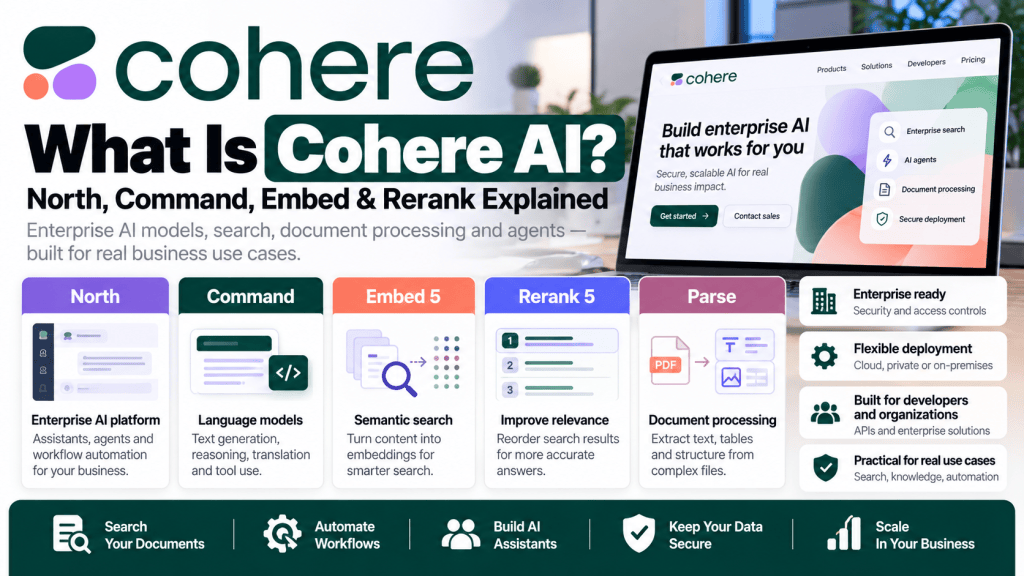
Its main offerings include North, Command, Embed, Rerank, and Parse.
But what does each product actually do, how much does Cohere cost, and how is it different from ChatGPT?
Here’s a practical breakdown.
What Is Cohere AI?
Cohere is an artificial intelligence company focused on enterprise applications.
Its products help organizations build AI-powered search systems, assistants, document-processing workflows, and automated business processes.
Unlike a service designed primarily around individual chatbot conversations, Cohere offers several technologies that developers and businesses can combine into their own applications.
For example, a company might use Cohere to:
- Search internal documents using natural language
- Summarize lengthy reports
- Build an AI assistant for employees
- Extract information from complex documents
- Improve search results in a knowledge base
- Create automated workflows using AI agents
- Deploy AI models in a controlled enterprise environment
Cohere provides both individual AI models through APIs and more complete enterprise solutions.
The right product depends on what you’re trying to build.
Cohere Products Explained: Quick Comparison
Cohere’s product names can be confusing if you’re new to enterprise AI.
Here’s a simple breakdown.
| Product | What It Does | Example Use |
|---|---|---|
| North | Enterprise AI assistant and agent platform | Internal employee assistant |
| Command | Generates and processes language | Answering questions or summarizing reports |
| Embed | Converts content into searchable numerical representations | Semantic document search |
| Rerank | Reorders search results by relevance | Improving knowledge-base answers |
| Parse | Extracts structured content from complex documents | Processing reports, tables, and forms |
| Compass | Enterprise search and information discovery | Searching across business knowledge sources |
These tools don’t all perform the same job.
Some generate answers, while others help find, organize, or prepare information.
Let’s look at the main products individually.
1. What Is Cohere North?
Cohere North is an enterprise AI platform designed to help employees work with business information and automate tasks.
Instead of building an entire AI application from scratch, organizations can use North as a more complete workplace solution.
According to Cohere’s official North documentation, the platform supports capabilities such as:
- AI-powered workplace assistants
- Enterprise search
- Custom AI agents
- Workflow automation
- Integration with business information sources
- Security and administrative controls
North is designed to connect AI capabilities with organizational knowledge and tools.
Example: An Internal HR Assistant
Imagine an employee asking:
“How many vacation days can I carry over into next year?”
A generic AI chatbot might provide an explanation of common vacation policies.
But a properly configured enterprise assistant could search the organization’s own HR policy and provide an answer based on that document.
It might also link to the relevant policy section.
This is particularly useful when answers depend on information that isn’t publicly available.
However, the accuracy of the answer still depends on the connected information, document quality, permissions, and system configuration.
Who Is North Best For?
North is most relevant to organizations that want a ready-made enterprise AI platform rather than building every component themselves.
Potential use cases include internal knowledge assistants, document workflows, and AI agents that work across connected systems.
For individual users who simply want a chatbot for personal productivity, a full enterprise platform may be unnecessary.
2. What Is Cohere Command?
Command is Cohere’s family of generative language models.
These models perform tasks involving natural language, including generating answers, summarizing information, and helping AI applications interact with tools.
Command is closer to the language-generation technology people associate with AI chatbots.
Cohere offers several model variants designed for different requirements.
Its current model documentation includes options such as Command A+, Command A, Command A Reasoning, Command A Vision, and smaller or specialized models.
Different models support different capabilities, so developers should check the specifications before selecting one.
What Can Command Do?
Command models can support:
- Question answering
- Document summarization
- Text generation
- Information extraction
- Multilingual tasks
- Tool-using AI agents
- Retrieval-augmented generation
For example, a business could use Command to summarize a long technical report into a short executive briefing.
Another application might use it to answer customer-support questions based on retrieved knowledge-base articles.
What Is Retrieval-Augmented Generation?
Retrieval-augmented generation, commonly called RAG, is a technique that combines information retrieval with an AI language model.
Instead of relying exclusively on information learned during model training, the application retrieves relevant documents and provides that information to the model.
For example:
- A user asks a question about a company policy.
- The system searches approved policy documents.
- Relevant passages are retrieved.
- Command receives the question and retrieved passages.
- The model generates an answer based on that context.
RAG can help make answers more relevant to organizational information.
However, it doesn’t guarantee factual accuracy. Retrieved documents can be outdated, incomplete, or misinterpreted.
Good implementations should also evaluate answer quality and handle uncertainty appropriately.
3. What Is Cohere Embed?
Cohere Embed helps applications search for information based on meaning rather than exact keywords alone.
It converts supported content into numerical representations called embeddings.
These numerical representations capture patterns that allow systems to compare how closely different pieces of information are related.
That may sound complicated, but the concept is straightforward.
Example: Searching an Employee Handbook
Imagine a document contains this sentence:
“Employees may request reimbursement for approved business travel expenses.”
An employee searches for:
“How do I get paid back for a work trip?”
Traditional keyword search might struggle because the question doesn’t use all the same words as the original policy.
Semantic search can recognize that both pieces of text concern reimbursement for business travel.
Embed provides representations that can support this kind of matching.
What’s New in Embed 5?
On September 30, 2026, Cohere announced the Embed 5 model family.
The release introduced two variants:
Embed 5 Pro
Designed for applications prioritizing retrieval quality, including complex document collections and quality-sensitive indexing.
Embed 5 Fast
Designed for lower latency and higher-throughput applications, including interactive search and workflows that issue many queries.
Cohere says both variants share an embedding space, allowing developers to combine them in supported workflows.
The models also support multilingual and multimodal retrieval use cases.
Cohere reports improvements over earlier generations, but independent testing on your own dataset is still important.
Read the official Embed 5 announcement.
4. What Is Cohere Rerank?
Rerank helps improve the relevance of search results.
Imagine searching an internal knowledge base for:
“How do I reset my company VPN password?”
The search system might retrieve 30 documents.
Some could be directly relevant, while others might only mention passwords or VPNs in unrelated contexts.
Rerank evaluates retrieved results against the question and places more relevant information higher in the results.
This can help an AI application select better supporting information.
Embed vs. Rerank: What’s the Difference?
These tools serve different purposes.
Embed helps find potentially relevant documents through semantic similarity.
Rerank evaluates and reorders an existing collection of results for a particular query.
A system can use either technology independently, but they can also work together.
For example:
- Embed helps retrieve candidate documents.
- Rerank prioritizes the most relevant candidates.
- Command generates an answer using selected content.
This combination can improve an AI search experience, especially when the organization has a large amount of information.
What’s New in Rerank 5?
Cohere announced Rerank 5 on October 21, 2026.
The family includes:
- Rerank 5 Pro: Designed for complex, reasoning-intensive retrieval.
- Rerank 5 Fast: Designed for lower-latency and higher-volume use cases.
The new models support multilingual search and introduce a capability called Context Focus.
What Is Context Focus?
Context Focus helps identify relevant passages within a document.
Instead of passing an entire lengthy document to a language model, an application can select the most relevant sections.
This may help reduce unnecessary processing and token usage.
However, not every task benefits from extracting only short passages.
For example, a question requiring a complete document summary may still need broader context.
Read Cohere’s official Rerank 5 documentation.
5. What Is Cohere Parse?
Businesses often store valuable information in files that aren’t easy for AI applications to process.
These include PDFs, presentation slides, scanned documents, and complex reports containing tables or images.
Cohere Parse is designed to extract information from such documents and convert it into a structured format.
It can help identify elements such as:
- Text
- Tables
- Lists
- Forms
- Images and captions
- Document layout information
Example: Processing a Financial Report
Imagine an organization receives a lengthy PDF report containing financial tables and explanatory notes.
A basic text extraction tool might struggle to preserve the structure of tables or the relationship between text and images.
A document parsing system attempts to extract the information in a way that downstream AI applications can use.
That output could then become searchable content.
However, document extraction is not guaranteed to be perfect.
Organizations should validate important extracted values, especially when dealing with financial, legal, medical, or other high-impact information.
How Does Parse Fit With Other Cohere Products?
Parse can prepare documents for a search or knowledge-processing pipeline.
For example:
Parse → Embed → Rerank → Command
Parse extracts content.
Embed makes that content searchable.
Rerank helps identify the most relevant results.
Command generates a response using the retrieved information.
This is one way the technologies can work together, not a requirement to use every product in every application.
Read Cohere’s Parse documentation.
How Cohere’s AI Products Work Together: A Practical Example
Let’s imagine a manufacturing company wants to build an internal troubleshooting assistant.
Its engineers maintain thousands of equipment manuals, maintenance procedures, and troubleshooting documents.
Employees want to ask questions such as:
“What should I check when this machine reports an overheating warning?”
The organization could build a system using several Cohere components.
| Step | Technology | What Happens |
|---|---|---|
| 1 | Parse | Extracts information from supported technical documents |
| 2 | Embed | Creates representations for semantic search |
| 3 | Search system | Retrieves potentially relevant document sections |
| 4 | Rerank | Prioritizes the most relevant results |
| 5 | Command | Generates a response using retrieved information |
| 6 | North | Can provide a broader enterprise interface and agent workflows |
In a well-designed system, the response could reference approved maintenance procedures.
However, such a tool should not replace required technician training, equipment safeguards, or established safety procedures.
The organization would still need appropriate access controls, document management, evaluations, and human oversight.
Cohere vs. ChatGPT: What’s the Difference?
It’s important to compare similar products.
ChatGPT is a conversational AI application, while Cohere is an AI technology provider with both models and enterprise applications.
That means comparing the entire Cohere business with ChatGPT alone isn’t quite an apples-to-apples comparison.
A more useful comparison is between Cohere North and enterprise AI assistants, or between Cohere Command and other language models.
| Feature | Cohere | ChatGPT / OpenAI Ecosystem |
|---|---|---|
| Conversational AI | Available through North and Command-based applications | Available through ChatGPT and OpenAI APIs |
| Language models | Command family | OpenAI model families |
| Enterprise agents | North and supporting models | Enterprise and developer agent capabilities |
| Search and retrieval | Embed, Rerank, Compass | Retrieval and search-related capabilities |
| Document processing | Parse and integrated workflows | Document and multimodal processing capabilities |
| API access | Yes | Yes |
| Enterprise deployment | Multiple managed and private options | Depends on product and enterprise offering |
Both ecosystems can support sophisticated AI applications.
The right choice depends on what you’re building.
When Might Cohere Be Worth Considering?
Cohere may be worth evaluating when your project focuses on enterprise search, information retrieval, or a specific private deployment requirement.
When Might ChatGPT Be More Convenient?
For an individual who mainly wants help writing, brainstorming, researching, or completing everyday tasks, an existing conversational AI product may be easier to start with.
For organizations, the comparison should include product features, governance, security, integration requirements, support, and total operating cost.
Neither option should be declared universally superior without testing the actual use case.
How Much Does Cohere AI Cost?
Cohere uses different pricing approaches depending on the product.
Cohere API Pricing
Cohere offers API access to supported models.
Pricing can depend on the model and type of request.
For example:
- Generative models commonly use token-based billing.
- Embedding models can use token-based pricing.
- Reranking models are priced according to search usage.
Actual prices vary by model and can change.
Is Cohere Free to Try?
Yes, Cohere provides free evaluation API keys with usage restrictions.
These are intended for testing and development, not unrestricted commercial production workloads.
Production use may require a paid API key or another deployment arrangement.
Cohere North Pricing
North is an enterprise product with custom pricing.
Organizations interested in North generally need to contact Cohere’s sales team.
There isn’t one publicly listed universal North subscription price that applies to every organization.
Private Deployment Pricing
Cohere also offers options for organizations that require more control over how and where their AI workloads run.
These may involve dedicated managed environments, private clouds, or on-premises infrastructure.
Costs depend on the deployment model and organizational requirements.
For current rates and terms, visit Cohere’s official pricing page.
Can You Use Cohere Without Coding?
It depends on the product.
North provides a business-oriented interface and tools for creating AI workflows, subject to an organization’s deployment and configuration.
Using the developer APIs generally requires programming knowledge or an application that already integrates the APIs.
If you’re comfortable with Python, JavaScript, or another supported development environment, you can explore Cohere’s API documentation.
For nontechnical users, the enterprise platform may be more accessible than building a custom application from scratch.
How to Get Started With Cohere
If you’re a developer curious about Cohere, a small test project is a practical starting point.
Step 1: Visit Cohere
Open cohere.com to explore the products.
Step 2: Review the Models
Read the official model documentation to understand which models support your intended task.
Step 3: Create an Evaluation API Key
Use the Cohere developer dashboard to obtain an evaluation key, subject to current eligibility and usage restrictions.
Step 4: Test One Small Use Case
For example, try summarizing a short document or improving search results for a small set of sample articles.
Avoid uploading confidential company information to an environment that hasn’t been approved for that purpose.
Step 5: Measure Results
Evaluate output quality, response time, cost, and reliability.
If your project involves retrieval, test whether the system actually identifies the correct source documents.
Step 6: Review Production Requirements
Before deploying an application for real users, confirm the appropriate API limits, commercial terms, privacy requirements, and infrastructure needs.
An evaluation key should not be treated as a production deployment solution.
Is Cohere AI Worth Using?
Cohere can be a compelling option for organizations building information-intensive AI applications.
Its products address several distinct challenges:
- North provides a broader enterprise AI workspace.
- Command generates and processes language.
- Embed supports semantic search.
- Rerank improves retrieved information.
- Parse prepares complex documents for downstream applications.
The main question is not whether Cohere has more features than a competing AI service.
It’s whether those capabilities solve your particular problem at an acceptable cost and level of reliability.
A small proof of concept using representative documents and tasks is often more useful than choosing a vendor based solely on marketing benchmarks.
Frequently Asked Questions
Is Cohere the same as ChatGPT?
No. Cohere is an enterprise AI technology company providing models and business platforms. ChatGPT is a conversational AI application developed by OpenAI. Some capabilities overlap, but the products are not identical.
Is Cohere a Canadian company?
Yes. Cohere is a Canadian-founded AI company headquartered in Toronto.
Is Cohere AI free?
Cohere offers limited free API evaluation access. Production API usage and enterprise platforms have separate commercial arrangements.
What is Cohere North used for?
North is designed for enterprise AI assistants, organizational knowledge access, custom agents, and workflow automation.
What is the difference between Embed and Rerank?
Embed helps represent and retrieve semantically related content. Rerank evaluates an existing set of search results and reorders them based on relevance to a query.
Does Cohere support private AI deployment?
Yes. Cohere offers several deployment options, including dedicated environments and certain on-premises or private-cloud configurations. Available options depend on the product and agreement.
Do I need North to use Command, Embed, or Rerank?
No. Developers can access supported models through Cohere APIs without adopting the complete North platform.
Final Verdict
Cohere is worth understanding if you’re interested in enterprise AI, document search, knowledge assistants, or AI-powered business workflows.
Rather than offering only a single chatbot experience, Cohere provides several technologies that solve different parts of the AI application development process.
For individual users, its developer tools may require more technical knowledge than a ready-made chatbot.
For organizations, its search, retrieval, automation, and deployment capabilities may make it an option worth testing.
The easiest way to remember Cohere’s main products is this: North organizes the workspace, Command generates answers, Embed finds related content, Rerank improves relevance, and Parse prepares documents.
Start with the problem you need to solve, then choose the tools that fit.
Official Sources and References
- Cohere — Official Website
- Cohere North — Enterprise AI Platform
- Cohere — Model Overview
- Cohere — Embed 5 Announcement — September 30, 2026.
- Cohere — Rerank 5 Announcement — October 21, 2026.
- Cohere — Parse Documentation
- Cohere — API Keys and Rate Limits
- Cohere — Pricing
- Cohere — Deployment Options
Disclaimer: Product specifications, available models, API limits, pricing, and deployment options may change. This article reflects publicly available Cohere documentation reviewed on October 30, 2026. It is an independent educational guide and is not sponsored by Cohere.

